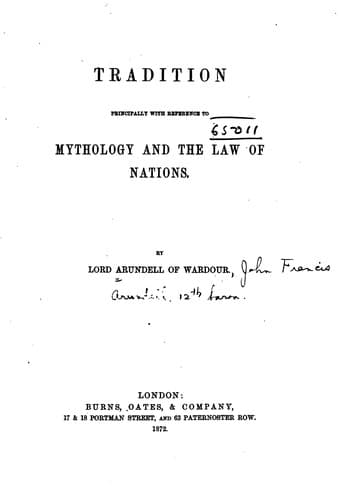
Tradition, Principally with Reference to Mythology and the Law of NationsArundell of Wardour, John Francis Arundell, Baron
Philosophy
Tradition, Principally with Reference to Mythology and the Law of Nations
Arundell of Wardour, John Francis Arundell, Baron
International law; Macdonell, George, 1780-1870; Mythology; Natural law; Tradition (Theology)
the equator, and bring the culminating glory of
the feast. So great a day must commence with
appropriate ceremonial, and _in this instance
it is bathing_. In country places the women run
early in the morning to the _nearest tank_ and
_plunge bodily in without undressing_." [This
is alluded to by Mr Gover as "an innovation so
uncomfortable and possibly dangerous;" but no
evidence is adduced of its being an innovation,
and its being the custom of the "country parts"
would incline us to the contrary belief.]
The men also bathe very carefully, as if the
occasion _were very solemn_. Reference is made
to the Rig Veda, i. 23, 15-24 (Wilson, i. 57);
but in these verses occur the words, "waters
take away whatever sin has been found in me."
"Dripping wet, the women proceed, without
changing their clothes, to prepare the feast,
... new chatties, or earthen vessels had been
purchased for the occasion; one of them is now
taken and is filled with rice, milk, sugar,
dholghee or clarified butter, grain, and other
substances, calculated to produce a tasty
dish.... The ingathering must be celebrated
with things that have just been garnered.
Usually Hindoos will not eat new rice, as it
is indigestible" (refer to Leviticus xxiii.
10-14). Another incident is that--"The head of
the house approaches the image (of Ganesa), and
performs pûja. Then follows a procession of
the young married couples to propitiate their
mothers-in-law.... So a present, the best the
house can provide, is carefully put together on
a tray. It may be fruit, or brass pots, or ghee,
or whatever else may be thought most acceptable.
Then a small procession is formed. In front
go three or four men, beating on tom-toms and
blowing pipes. Then follows the gift, held
aloft. Over it, if the family be respectable,
is held an umbrella, carried by a servant who
walks behind the bearer of the gift.... The
nearest relative steps forward and asks that
the daughter and her husband may come to the
'boiling,' to fill up the family circle. Then
follows the boiling of the pot; 'as the milk
boils, so will the coming year be.' The Pongol
is one long series of visits, entertainments,
and social joys." (Comp. Mandan Festival,
_supra_.)
Public-domain text, read in full here on John Shaqi.
Reviews
Reviews
No reviews yet
Be the first to share your thoughts on this work.
Elsewhere in the archive
Join the Discussion
Join the discussion
Sign in to leave a comment or review.
Sign InorCreate an account