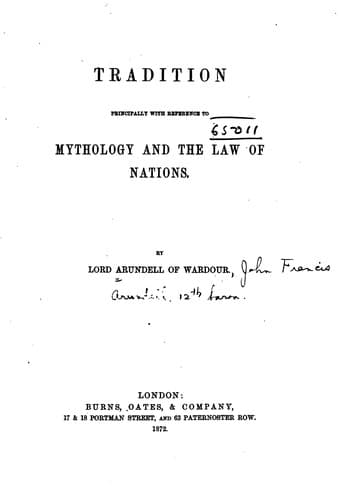
Tradition, Principally with Reference to Mythology and the Law of NationsArundell of Wardour, John Francis Arundell, Baron
Philosophy
Tradition, Principally with Reference to Mythology and the Law of Nations
Arundell of Wardour, John Francis Arundell, Baron
International law; Macdonell, George, 1780-1870; Mythology; Natural law; Tradition (Theology)
"The second festival takes place in the autumn;
it is celebrated in honour of Houacouvou
(_director of_ the evil spirits). The object
of it is to conjure him to preserve them from
all enchantment. As in the first festival, the
Indians dress themselves in their best, and
assemble by tribes only, headed by their cacique.
An assemblage of _all the cattle_ takes place
_en masse_. The men form a double circle around,
galloping unceasingly in opposite directions, so
that none of these unruly animals may escape.
They invoke Houacouvou aloud, throwing down, drop
by drop, fermented _milk_ out of _bull's horns_,
handed to them _by their wives_, while they are
riding round the cattle. After repeating this
ceremony three or _four_ times, they sprinkle
the horses and oxen with whatever remains of the
milk, with the view, they say, of preserving
them from all maladies; this done, each man
_separates his own cattle_, and _drives it to
some distance_, then returns for the purpose of
assembling round the cacique, who, in a long and
fervid address, advises them never to forget
Houacouvou in their prayers, and to lose no
time in preparing themselves to please him, by
carrying desolation amongst the Christians, and
increasing the number of their own flocks and
herds."
This festival, therefore, in its original
conception would not appear to be a worship of
the evil spirit, but of him who curbs him; the
same idea of the subordination of the evil spirit
will be seen in Catlin's account of the Mandans.
There is nothing certainly in this account which
directly connects these Patagonian ceremonies
with the diluvian commemorations, unless,
perhaps, the sacred drum; but there is much in
common with the Pongol and the Mandan which we
have seen to have been commemorative.
Public-domain text, read in full here on John Shaqi.
Reviews
Reviews
No reviews yet
Be the first to share your thoughts on this work.
Elsewhere in the archive
Join the Discussion
Join the discussion
Sign in to leave a comment or review.
Sign InorCreate an account