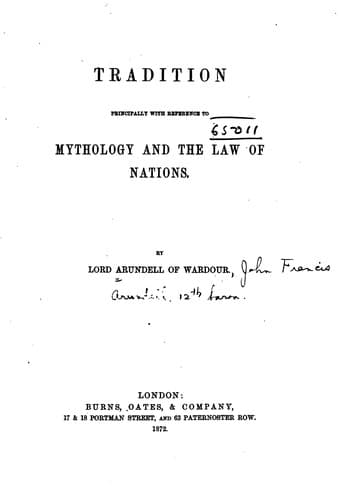
Tradition, Principally with Reference to Mythology and the Law of NationsArundell of Wardour, John Francis Arundell, Baron
Philosophy
Tradition, Principally with Reference to Mythology and the Law of Nations
Arundell of Wardour, John Francis Arundell, Baron
International law; Macdonell, George, 1780-1870; Mythology; Natural law; Tradition (Theology)
The prominence of sun worship will not have
escaped observation; but this discovery cannot
militate against my position, for I have already
shown (p. 160) that such admixture was
probable, and also indicated how it was likely
to have come about. Any hostile argument which
would seek to deprive those ceremonies of their
significance must be directed to the extrusion of
the diluvian symbols.
Further trace of these diluvian ceremonies
might be traced in the Buddhist systems; but
it would open out too large a question for
discussion here.
CHAPTER XII.
_SIR JOHN LUBBOCK ON TRADITION._
DE MAISTRE'S VIEW.[234]
"We have little knowledge of the times which preceded the
Deluge.... A single consideration interests us, and it must
never be lost sight of, and that is, that chastisements are ever
proportioned to crimes, and crimes always proportioned to the
knowledge of the criminal; in such sort that the Deluge supposes
unheard-of crimes, and that these crimes suppose a knowledge
infinitely transcending that which we possess.... This knowledge,
freed from the evil which had rendered it so noxious, survived in
the first family the destruction of the human race. We are blinded
as to the nature and advance of science by a gross sophism which
has fascinated every eye; it is to judge of times when men saw
effects in their causes by those in which men painfully ascend from
effects to causes, in which they are only concerned with effects,
in which they say it is useless to occupy themselves with causes,
and in which they do not know what constitutes a cause. They never
cease repeating--'Think of the time that has been required to know
such and such a thing.' What inconceivable blindness! A moment only
was required. If man would know the cause of a single phenomenon of
nature, he would probably comprehend all the rest. We are unwilling
to see that truths, the most difficult to discover, are very easy
to understand.... 'These things,' as Plato says, 'are perfectly
and easily learned if any one teaches them, [Greek: ei didaskoi
tis]; but,' he adds, 'no one will teach them us, unless, indeed,
God shows him the road, [Greek: all oud an didaxeien ei mê Theos
yphêgoito].' 'I doubt not,' said Hippocrates, 'that the arts were
in the first instance favours ([Greek: theôn charitas]) granted to
men by the gods.'... Listen to sage antiquity in its account of the
first men: it will tell you that they were marvellous men, and that
beings of a superior order deigned to favour them with the most
precious communications. On this point there is no disagreement,
...
Public-domain text, read in full here on John Shaqi.
Reviews
Reviews
No reviews yet
Be the first to share your thoughts on this work.
Elsewhere in the archive
Join the Discussion
Join the discussion
Sign in to leave a comment or review.
Sign InorCreate an account