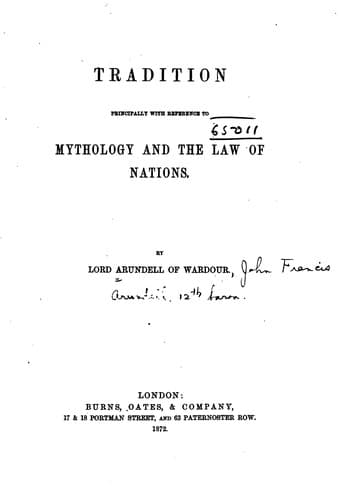
Tradition, Principally with Reference to Mythology and the Law of NationsArundell of Wardour, John Francis Arundell, Baron
Philosophy
Tradition, Principally with Reference to Mythology and the Law of Nations
Arundell of Wardour, John Francis Arundell, Baron
International law; Macdonell, George, 1780-1870; Mythology; Natural law; Tradition (Theology)
reason, revelation, all human tradition make up a demonstration
which the mouth only can contradict. Not only, then, did mankind
commence with science, but with a science different from ours, and
superior to ours.... No one knows to what epoch remounts, I do not
say the early commencements of society, but the great institutions,
the profound knowledge, and the most magnificent monuments of
human industry and human power.... Asia, having been the theatre
of the greatest marvels, it is not astonishing that its people
should have preserved a leaning to the marvellous stronger than
what is natural to man in general, and than each one recognises in
himself individually. Hence it comes that they have always shown
so little taste and talent for our science of _conclusions_. One
would say rather that they recalled something of primitive science
and of the era of intuition. Would the enchained eagle ask for a
balloon to raise himself into the air? No, he would demand only
that his fetters should be broken. And who knows if these people
are not destined yet to contemplate sights which will be refused
to the cavilling genius of Europe? However this may be, observe,
I pray you, that it is impossible to think of modern art without
seeing it constantly environed with all the contrivances of the
intellect and all the methods of art.... On the contrary. So far as
it is possible to discover the science of primitive times at such
an enormous distance, we see it always free and isolated, flying
rather than marching, and presenting in all its characteristics
something of the ærial and supernatural.[235]... But then comes
the corollary.... If all men descend from the three couples who
repeopled the universe, and if the human race commenced with
knowledge, the savage cannot be more, as I have said to you, than
a branch detached from the social tree.... Now, what matter does
it make at what epoch such and such a branch was separated from
the tree? It suffices that it is detached: no doubt as to its
degradation; and I venture to say no doubt as to the cause of
degradation, which can only have been some crime. A chief of a
nation having altered the principle of morality in his household
by one of those prevarications which, so far as we can judge, are
no longer possible in the actual state of things, because happily
our knowledge is no longer such as to allow us to become culpable
in this degree; this chief of a nation, I say, transmits the curse
to his posterity; and every constant force being accelerating
in its nature, this degradation, weighing incessantly upon his
descendants, has ended in making them what we call _savages_. Two
causes extremely different have thrown a deceptive cloud over the
lamentable state of savages: the one of ancient date, the other
belonging to our century.... One cannot for an instant regard
Public-domain text, read in full here on John Shaqi.
Reviews
Reviews
No reviews yet
Be the first to share your thoughts on this work.
Elsewhere in the archive
Join the Discussion
Join the discussion
Sign in to leave a comment or review.
Sign InorCreate an account