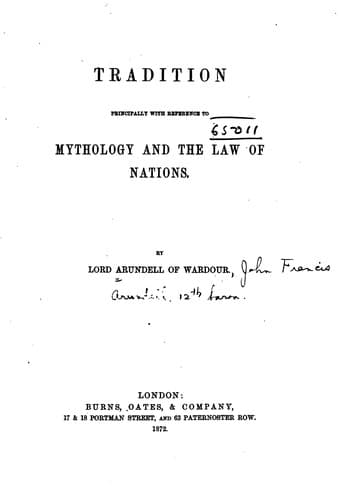
Tradition, Principally with Reference to Mythology and the Law of NationsArundell of Wardour, John Francis Arundell, Baron
Philosophy
Tradition, Principally with Reference to Mythology and the Law of Nations
Arundell of Wardour, John Francis Arundell, Baron
International law; Macdonell, George, 1780-1870; Mythology; Natural law; Tradition (Theology)
"No language could possibly have been invented, either by a single
man, who could not have extorted obedience, or by many who would
not have made themselves understood to each other.... But I would
wish, before concluding this subject, to recommend to your notice
an observation which has always struck me. Whence comes it that in
the primitive language of every ancient people, we find words which
necessarily suppose a knowledge foreign to these people? Whence,
for instance, have the Greeks, three thousand years ago at least,
found the epithet 'physizoos' (giving or possessing life), which
Homer sometimes gives to the earth?.... Where have they taken the
still more singular epithet of 'philomate' (liking or thirsting for
blood), given to this same earth in a tragedy? (Euripides, Phoen.
v. 179). Æschylus had alluded before 'to the earth drinking the
blood of the two rival brothers, the one slain by the other.'[237]
Humboldt ('Monum. des Peuples Indigènes de l'Amerique,' Paris,
1816) has said: 'Many idioms which at present belong only to
barbarous nations seem to be the remains of rich and flexible
languages, which indicate a high culture.... But tell me, I pray
you, how it entered the heads of the ancient Latins, at a time when
they were only acquainted with the arts of war and of tillage, to
express by the same word the idea of prayer and of punishment? Who
taught them to call fever the "purifier," or the "expiator"?'[238]
Would not one say that there was here a judgment, a veritable
knowledge of the cause, by virtue of which the people affirmed the
name so justly? But do you believe that these sorts of judgments
could possibly have belonged to a time when they scarcely knew
how to write, when the Dictator dug his garden, and in which they
composed verses which Varro and Cicero no longer understood?... The
Greeks had preserved some obscure traditions in this regard--[Mr
Gladstone has shown them to be neither few nor obscure],--and who
knows if Homer does not attest the same truth, perhaps without
knowing it, when he speaks of certain men and certain things 'which
the gods called after one manner, and men after another?'"--_Count
Joseph de Maistre, "Soirées de St Petersbourg,"_ i. _Deux:
Entretien._[239]
[237] Compare with Gainet, i. 92, 93.
Public-domain text, read in full here on John Shaqi.
Reviews
Reviews
No reviews yet
Be the first to share your thoughts on this work.
Elsewhere in the archive
Join the Discussion
Join the discussion
Sign in to leave a comment or review.
Sign InorCreate an account