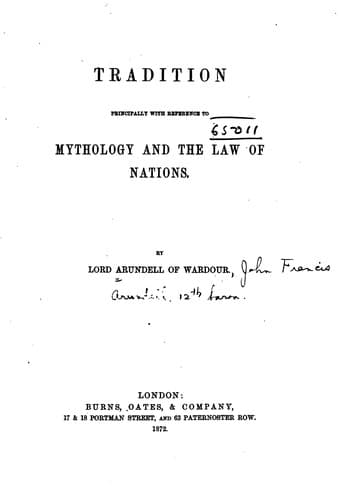
Tradition, Principally with Reference to Mythology and the Law of NationsArundell of Wardour, John Francis Arundell, Baron
Philosophy
Tradition, Principally with Reference to Mythology and the Law of Nations
Arundell of Wardour, John Francis Arundell, Baron
International law; Macdonell, George, 1780-1870; Mythology; Natural law; Tradition (Theology)
[238] "Now it is clear that the train of thought which leads from
purification to penance, or from purification to punishment,
reveals a moral and even a religious sentiment in the
conception and naming of poena, and it shows us that in
the very infancy of criminal justice punishment was looked
upon (Mr Max Müller is speaking with reference to what I may
call briefly the Sanscrit epoch) not simply a retribution or
revenge, but as a correction, as a removal of guilt. We do not
feel the presence of these early thoughts when we speak of
corporal punishment or castigation; yet _castigation_ too was
originally chastening, from '_castus_,' pure; and 'incestum'
was impurity or sin, which, according to Roman law, the
priests had to make good, or to punish by a 'supplicium,' or
supplication or prostration before the gods."
[239] Compare with Max Müller, "Chips," ii. 256.
Against this view of De Maistre, which I consider to be indirectly
sustained by the testimony of all antiquity, stands the theory of
Sir John Lubbock. There is the constant historical tradition and
testimony of the human race on one side, and there is the history of
"Pre-historic Times" on the other. Nevertheless, I venture to say, that
the author of "Pre-historic Times" only takes up with man at the point
where De Maistre leaves him.
Of course I do not seek to detach Sir John Lubbock from the evidence he
has collected; neither do I forget that he is the representative of an
opinion and a school; at any rate, that there is an opinion of which he
is the most conspicuous exponent.
So far as my limited acquaintance with the special subjects with which
Sir John Lubbock deals extends (and with these I am only indirectly
concerned), he appears perfectly straightforward and candid; and,
moreover, I must acknowledge my obligations to him, for he has
written with remarkable breadth and ability; and it is with the aid
of the interesting matter which he has accumulated,[240] expressly in
disparagement of tradition, that I venture to undertake to reinstate it
in honour.
[240] _Vide_ chapter on Savage Life in "Pre-historic Times."
Neither do I wish to ignore that Sir John Lubbock's main argument is
the geological argument derived from the discovery of the fossils and
implements in the drift. But on this point I beg to be allowed to say a
word in protest.
Public-domain text, read in full here on John Shaqi.
Reviews
Reviews
No reviews yet
Be the first to share your thoughts on this work.
Elsewhere in the archive
Join the Discussion
Join the discussion
Sign in to leave a comment or review.
Sign InorCreate an account