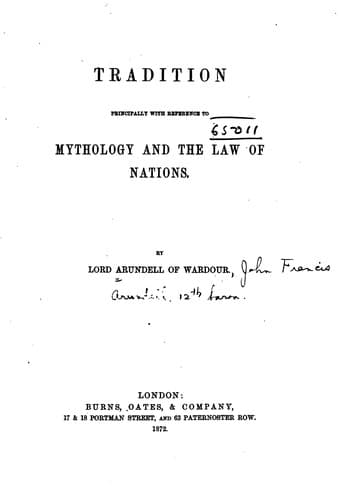
Tradition, Principally with Reference to Mythology and the Law of NationsArundell of Wardour, John Francis Arundell, Baron
Philosophy
Tradition, Principally with Reference to Mythology and the Law of Nations
Arundell of Wardour, John Francis Arundell, Baron
International law; Macdonell, George, 1780-1870; Mythology; Natural law; Tradition (Theology)
[257] Compare the following passage in the Bishop of Chalons' "Le
Monde et l'Homme Primitif" (with reference to Gen. i.--the
Creation). At p. 11 the Bishop says, "That when the Book
of the Law of Manou and the Mahabarata relate that God,
who contains within Himself his own principle in the first
instance, the water, and gave it fecundity, and that the
produce of this fecundity became _an egg_, ... can we see in
this anything else than the fantastic translation of this
phrase of Scripture, 'L'esprit de Dieu _couvait_ la surface
des eaux--Rouha Elohim meharephet hal pene hammaïm.'" _Vide_
also p. 11 (as to universality of tradition) and p. 34 as to
text also. J. G. Vance ("Archæol." xix.) says, upon the
mundane egg "the whole system of ancient religion was based"
(J. B. Waring, "Stone Monuments of Remote Ages," p. 5, 1870).
It strikes me that it would be difficult to assign a Christian
origin for the custom. It must then have been a custom which the
Church diverted or sanctioned in giving it an innocent or Christian
application; in which case, in so far as it is pagan, it may possibly
be traced to a common origin with the practices in Khasia among the
Lepchas.
It would extend the inquiry too far to follow Sir J. Lubbock through
all the cases adduced by him. I will conclude, therefore, with his
account of the Andaman islander--who, with the Australians, Esquimaux,
and Fuegians, dispute the point of being considered the lowest of
mankind. It is said of the Andamans, "that they have no idea of
a Supreme Being, no religion, or any belief in a future state of
existence" (p. 346). It is, however, casually mentioned that, "after
death, the corpse is buried in a sitting posture." Now this mode of
burial is common to them with Esquimaux (p. 409), the Australians (p.
353), the Maories (p. 369), and the natives of the Feegee Islands
(p. 361), among whom we seem to get a clue to this strange mode of
burial; "the fact is, _they_ (the Feegee islanders) not only believe
in a future state, but are persuaded that as they leave this life, so
will they rise again." Sir J. Lubbock, in his "Introduction to Prof.
Nillson" (xxxiii.), says that this was the common mode of burial in
the Stone Age; and Prescott ("Hist. of Mexico," ii. 485) says, "Who
can doubt the existence of an affinity, or at least an intercourse,
between tribes, who had _the same strange habit of burying the dead in
a sitting position_, as was practised to some extent by most if _not
all_ of the aborigines from Canada to Patagonia?"[258] But not only may
it be presumed that they had an affinity and intercourse, but a common
religious idea. It may be doubted then whether even the naked Andaman
is so entirely destitute of all religious impressions as he is supposed
to be.
Public-domain text, read in full here on John Shaqi.
Reviews
Reviews
No reviews yet
Be the first to share your thoughts on this work.
Elsewhere in the archive
Join the Discussion
Join the discussion
Sign in to leave a comment or review.
Sign InorCreate an account