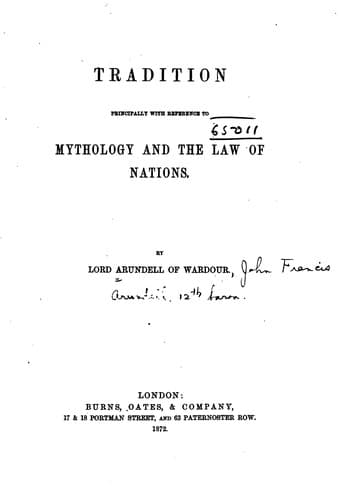
Tradition, Principally with Reference to Mythology and the Law of NationsArundell of Wardour, John Francis Arundell, Baron
Philosophy
Tradition, Principally with Reference to Mythology and the Law of Nations
Arundell of Wardour, John Francis Arundell, Baron
International law; Macdonell, George, 1780-1870; Mythology; Natural law; Tradition (Theology)
It is plain that there is here question of restlessness rather than
of violence; but grant that there was violence too, the account of
Mr. Hunter when examined, so far from conflicting with, appears to me
to fall exactly into, the lines I have indicated. Is not the scene,
from before which Mr. Hunter lifts the curtain, the scene of that age
following the dispersion (of which, p. 452, there is such distinct
tradition in his pages), which is traditionally known to us as the iron
age? The error, then, of Mr. Hunter is to confound the patriarchal with
the iron age. It need not therefore cause surprise that in early Indian
history we should hear of conflict, for it is just at the period and
under the circumstances when we should consider the collision probable.
Mr. Hunter, indeed, speaks of the aboriginal races as mysterious in
their origin. But from the point of view of Genesis, there seems to
be no greater mystery about them than about their conquerors the
Aryans. One representative, at least, of the aboriginal race, the
Santals, retain to this day the most vivid traditions of the Flood
and the Dispersion[33] (pp. 151, 452). Now, if there had existed any
race anterior to the Santals, I think we should have heard of them.
On this point we may consider Mr. Hunter's negative testimony as
conclusive, both on account of his extensive knowledge of the subject,
and his evident predisposition (p. 109) to have discovered a prior
race, if it had existed; and there is nothing to show that the same
line of argument would not have applied to it if its existence had
been demonstrated. It must be mentioned that besides their tradition
of the dispersion, the Santals retain dim recollections--borne out
by comparative evidence--of having travelled to their present homes
from the north-east, whereas the Aryans came unmistakeably from the
north-west.
[33] These legends, shown to be aboriginal, are very curious. They
are, however, too long to be extracted here. They would repay
perusal.
Here, then, just as might have been predicted _à priori_, these rival
currents of the dispersion met from opposite points, and ran into a
_cul de sac_, from which, as there was no egress, there necessarily
ensued a struggle for mastery.
Let us now regard the two people more closely.
Public-domain text, read in full here on John Shaqi.
Reviews
Reviews
No reviews yet
Be the first to share your thoughts on this work.
Join the Discussion
Join the discussion
Sign in to leave a comment or review.
Sign InorCreate an account