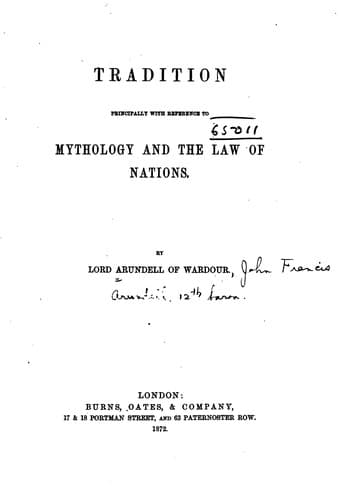
Tradition, Principally with Reference to Mythology and the Law of NationsArundell of Wardour, John Francis Arundell, Baron
Philosophy
Tradition, Principally with Reference to Mythology and the Law of Nations
Arundell of Wardour, John Francis Arundell, Baron
International law; Macdonell, George, 1780-1870; Mythology; Natural law; Tradition (Theology)
"Our earliest glimpses of the human family in India, disclose two
tribes of widely different origin, struggling for the mastery. In
the primitive time, which lies on the horizon even of inductive
history, a tall, fair-complexioned race passed the Himalaya. They
came of a conquering stock. They had _known the safety_ and the
_plenty_ which can only be enjoyed in regular communities.[34]
_They brought with them a store of legends_ and devotional strains;
and chief of all they were at the time of their migration southward
through Bengal, if not at their first arrival in India, imbued
with that high sense of nationality, which burns in the heart
of a people who believe themselves the _depositary of a divine
revelation_. There is no record of the newcomers' first struggle
for life with the people of the land."--_Hunter's Annals_, p. 90.
Here we see the more intellectual, the more spiritual (p. 116),
monotheistic (p. 115) Aryan race overpowering the black race which had
earliest pre-occupied the ground, and which was already tainted with
demon worship. This contrast invites further inquiry; but first let me
clear up and direct the immediate drift of my argument.
[34] Mr Max Müller also says ("Chips," ii. p. 41)--"It should be
observed that most of the terms connected with the chase and
warfare differ in each of the Aryan dialects, while words
connected with more peaceful occupations belong, generally,
to the common heirloom of the Aryan language," which proves
"that all the Aryan nations had led _a long life of peace
before they separated_, and that their language acquired
individuality and nationality, as each colony started in
search of new homes,--new generations forming new terms
connected with the warlike and adventurous life of their
onward migrations. Hence it is that _not only Greek and Latin,
but all Aryan_ languages have their peaceful words in common."
Also _vide_ p. 28, 29.
If we estimate--taking the minimum or the maximum either according to
the Hebrew or Septuagint version--the time it would have taken these
populations, according to the slow progress of the dispersion, to have
arrived at their destinations from the plain of Sennaar (Mesopotamia),
the period may be equally conjectured to correspond with that which
tradition marks as the commencement of the iron age, when the world
was becoming overcrowded, and the increasing populations came into
collision.
Public-domain text, read in full here on John Shaqi.
Reviews
Reviews
No reviews yet
Be the first to share your thoughts on this work.
Join the Discussion
Join the discussion
Sign in to leave a comment or review.
Sign InorCreate an account