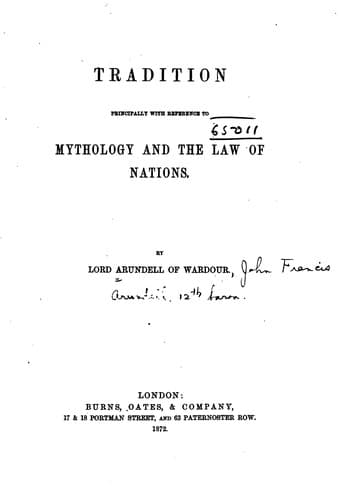
Tradition, Principally with Reference to Mythology and the Law of NationsArundell of Wardour, John Francis Arundell, Baron
Philosophy
Tradition, Principally with Reference to Mythology and the Law of Nations
Arundell of Wardour, John Francis Arundell, Baron
International law; Macdonell, George, 1780-1870; Mythology; Natural law; Tradition (Theology)
Neither is it a difficulty,[35] it rather appears to me in accordance
with tradition, that if this surmise be correct, the earliest arrival
in the Indian Peninsula should have been of those who took the longest
route. For it is natural to suppose that the proscribed and weakest
races, _e.g._ the Canaanitish, would have been the first to depart, and
to depart by the north-east and west, the more powerful families having
passed down and closed the south-east exit by way of the lower valleys
of the Euphrates. These latter would have spread themselves out in the
direction of India leisurely and at a subsequent period.
[35] I find this conjecture confirmed in the pages of the most
recent authority on the subject, Mr Brace, "Ethnology," p. 13,
14--"On the continent of Asia the Turanians were probably the
first who figured as nations in the ante-historical period.
Their emigrations began long before the wanderings of the
Aryans and Semites, who, wherever they went, always discovered
a previous population, apparently of Turanian origin, which
they either expelled or subdued." According to Max Müller's
hypothesis there were two migrations, one northern and one
southern [corresponding to the migration as above], "the
_latter_ settling on the rivers Meikong, Meinam, _Irrawaddy_,
and _Bramapootra_," ... "a third to the south [probably an
advance of the previous one], is believed to tend toward
Thibet and India, and in later times pours its hordes _through
the Himalaya_, and forms the _original population of India_."
Analogy may be discovered in "the two streams or lines of
Celtic migration," which, says Bunsen ("Philosophy of Univ.
Hist." i. 148) "we may distinguish by the names of the Western
and Eastern stream, the _former_, although the _less direct_,
seems to be historically the more ancient, and to have reached
this country (Britain) _several centuries_ before _the other_."
Following these lines of migration, the Aryan at some period came upon
the black Turanian race (_vide infra_, Chap. v.); and Mr Hunter (p.
110) records the embittered feelings with which the recollection of
the strife remained in tradition. Why should this have been? It might
suffice to say, in consistency with what has already been advanced,
that this was their first encounter, the first check in their advance.
Public-domain text, read in full here on John Shaqi.
Reviews
Reviews
No reviews yet
Be the first to share your thoughts on this work.
Join the Discussion
Join the discussion
Sign in to leave a comment or review.
Sign InorCreate an account