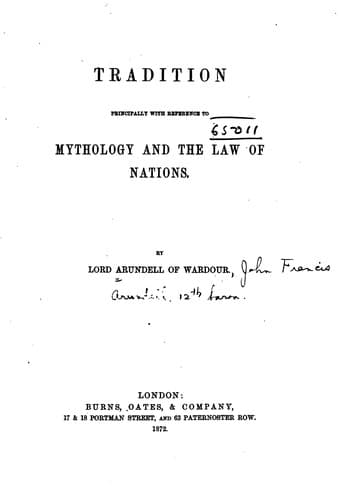
Tradition, Principally with Reference to Mythology and the Law of NationsArundell of Wardour, John Francis Arundell, Baron
Philosophy
Tradition, Principally with Reference to Mythology and the Law of Nations
Arundell of Wardour, John Francis Arundell, Baron
International law; Macdonell, George, 1780-1870; Mythology; Natural law; Tradition (Theology)
Another solution seems to me equally ready to hand, and to solve so
much more. But first, how does Mr Hunter account for this bitter
feeling? He suggests contempt for their "uncouth talk," "their gross
habits of eating," and, what comes near to the truth, as I apprehend
it, their blackness and their paganism. Suppose, then, we go a step
further, and say that the highly intellectual Japhetic race met thus
suddenly and unexpectedly the outcast Canaanitish race, with the curse
upon them, recognisable in their colour and deficiencies, and of whom
they would have remembered that it had been said, "that they should be
the servants of their brethren"--will not this explain something of
their animosity?
I must here remark that although scientific inquiry takes designations
of its own, in order the more conveniently to express its distinctions,
yet whether we accept the ethnological or philological demarcations of
mankind, it is curious how inevitably, as I think De Maistre remarked,
we are led back to Shem, Ham, and Japhet. And this is as true now after
a half century of scientific progress, as it was when De Maistre wrote.
Without asserting that the divisions may ever be distinctly traced with
the minuteness of Bochart in his "Geog. Sacra," I still say, that the
broad lines of the traditional apportionment of the world, and the
three-fold or four-fold division of the race indicated in Scripture,
is seen behind the ultimate divisions into which science is brought
to separate mankind, whether into Caucasian, Ethiopian, Mongol, with
two intermediate varieties, as by Blumenbach; or into Australioid,
Negroid, Mongoloid, and Xanthochroic, as by Huxley; or into Brace's
division into Aryan, Semitic, Turanian, and Hamitic. Behind these
various systems, as behind a grill, we seem to see the forms and faces
of the progenitors of the human race discernible, but their existence
not capable of contact and actual demonstration, because of the
intercepting bars and lattice work.[36]
[36] I am throughout assuming acquaintance, on the part of my
readers, with the third and fourth of Cardinal Wiseman's
"Lectures on Science and Revealed Religion;" for although
my argument is distinct from that of the Cardinal, yet I
everywhere regard his argument as the background and support
of my position; and it is, moreover, part of the aim and
intention of this work to show that the general ground and
framework (this is, in fact, understating the truth) of
Cardinal Wiseman's argument remains intact. There is, I think,
somewhere in the Cardinal's works, a passage to the above
effect, but I have not been able to recover it.
Public-domain text, read in full here on John Shaqi.
Reviews
Reviews
No reviews yet
Be the first to share your thoughts on this work.
Join the Discussion
Join the discussion
Sign in to leave a comment or review.
Sign InorCreate an account