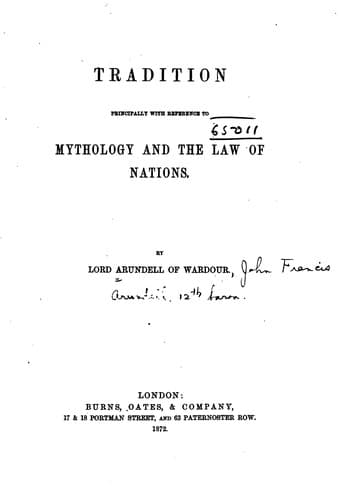
Tradition, Principally with Reference to Mythology and the Law of NationsArundell of Wardour, John Francis Arundell, Baron
Philosophy
Tradition, Principally with Reference to Mythology and the Law of Nations
Arundell of Wardour, John Francis Arundell, Baron
International law; Macdonell, George, 1780-1870; Mythology; Natural law; Tradition (Theology)
I have spoken above of a three-fold and four-fold division as equally
indicated in Scripture, and I think, from non-observance of this, the
close approximation of these systems to Genesis is not sufficiently
recognised. I refer to the three progenital races, and the Canaanite
marked off and distinguished from the rest by a curse. I shall enlarge
upon this point in another chapter (Chap. v).
I will only observe now that I do not venture to say that the Canaanite
is co-extensive with the Turanian, which is more a philological than
an ethnological division of mankind, or that their characteristics in
all respects correspond.[37] I limit my argument now to indicating the
correspondence between the Canaanite and the aboriginal tribes in India.
[37] If space allowed, I think the traditional lines might be
indicated as plainly from the philological as from the
ethnological point of view.
This correspondence I find not only in the features already
noted--their blackness and their intellectual inferiority--but in their
enslavement to the superior races of mankind whenever they came into
contact and collision with them. Is not this everywhere also the mark
of the Turanian race? are not these conflicts in primitive life always
with the Turanian race? and are they not in Asia, as in Africa, in a
state of subjugation or dependence?
At any rate, this is the condition in which we find the Turanian in
India, so fully expressed in their name of "Sudras."[38]
[38] "According to the sacred law-book, entitled the Ordinances of
Menu, the Creator, that the human race might be multiplied,
caused the Brahmin, Cshatriya, the Vaisya, and the _Sudra_ (so
named from Scripture, protection, wealth, and _labour_), to
proceed from his mouth, arm, thigh, and foot."--_Brit. Ency._
The "Fatimala," a Sanskrit work on Hindu castes, says, "the
other, _i.e._, the Sudra, should voluntarily serve the three
other tribes, and therefore he became a Sudra; he _should_
humble himself at their feet."
Public-domain text, read in full here on John Shaqi.
Reviews
Reviews
No reviews yet
Be the first to share your thoughts on this work.
Elsewhere in the archive
Join the Discussion
Join the discussion
Sign in to leave a comment or review.
Sign InorCreate an account