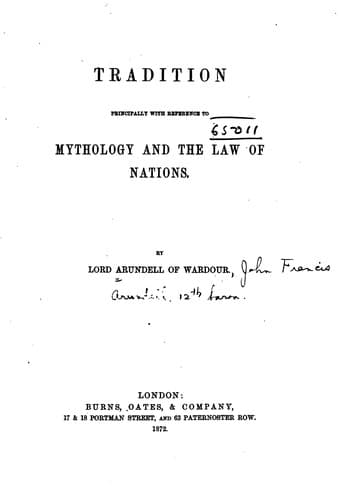
Tradition, Principally with Reference to Mythology and the Law of NationsArundell of Wardour, John Francis Arundell, Baron
Philosophy
Tradition, Principally with Reference to Mythology and the Law of Nations
Arundell of Wardour, John Francis Arundell, Baron
International law; Macdonell, George, 1780-1870; Mythology; Natural law; Tradition (Theology)
Against this literal fulfilment of Gen. ix. 25--"Cursed be Canaan, a
servant of servants shall he be to his brethren"--as regards the Indian
Sudra, the text in Gen. x. 19--"And the limits of Chanaan were from
Sidon ... to Gaza ... even to Sesa"--may be objected. But I construe
this text only to refer to Chanaan proper, and to be spoken rather with
reference to the limits of the Promised Land and the Hebrews, than
to the allocation of the tribes of Chanaan; for the text immediately
preceding seems to me to have its significance--viz. Gen. x. 18,[39]
where it is said in a marked manner, and of the descendants of Chanaan
alone, "The families of the Canaanites were spread abroad." But if
we are to suppose the whole descent of Chanaan to have been confined
between the limits of Sidon and Sesa, it could hardly have been said to
have had the diffusion of the other Hamitic races, and the _families_
of the Chanaanites will not have been "spread abroad" in any noticeable
or striking manner. It appears to me, also, that it may be proved in
another way. St Paul, Acts xiii. 19, says that God destroyed _seven_
nations in the land of Chanaan, whereas Gen. x. enumerates eleven.
[39] Homer's expression (Od. i. 23, 24), that the Ethiopians
divided in twain, were the _most remote_ of men--
[Greek: "Athiopas, toi dichtha dedaiatai eschatoi andrôn,
Hoi men dysomenoi Yperionos oi d' aniontos,"]
approximates to the scriptural phrase, and seems to imply a wider
dispersion than is suggested by Professor Rawlinson, i. 59.
Again, Kalisch ("Hist. and Crit. Com. on Old Testament," trans. 1858)
makes it a difficulty against Gen. ix. that "Canaan _should_ not only
fall into the hands of Shem, _i.e._ the people of Israel, but also of
_Japhet_" (i. 226).
A remote fulfilment of the prediction may be seen in the Median
conquest of Phoenicia, and the Roman destruction of Carthage; but if
I have truly indicated the order of events, it will be seen that it had
already come about in the earliest times.
The text, indeed, of Gen. ix. 27--"May God enlarge Japhet, and may he
dwell in the tents of Shem, and Canaan be his servant"--is so clear as
almost to require some such fulfilment.
But the fulfilment is seen, not only in the degradation of Chanaan, but
in the prosperity of Japhet;[40] and this is so correlative, that I
shall still be enforcing the argument whilst connecting a link which
may appear to be wanting, viz. the identity of Japhet with the more
favoured nations of the world. The identity of the Indo-Germanic races
with the descendants of Japhet may almost be said to be a truth "_qui
saute aux yeux_," but it may still be worth while to collect the links
of tradition which establish it.
Public-domain text, read in full here on John Shaqi.
Reviews
Reviews
No reviews yet
Be the first to share your thoughts on this work.
Elsewhere in the archive
Join the Discussion
Join the discussion
Sign in to leave a comment or review.
Sign InorCreate an account