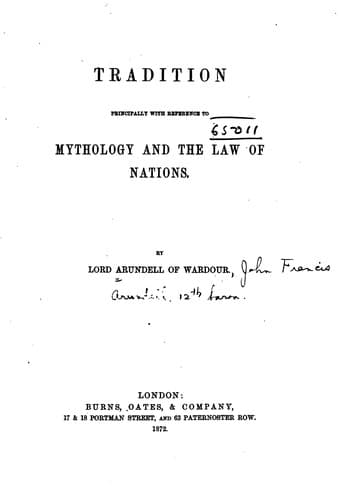
Tradition, Principally with Reference to Mythology and the Law of NationsArundell of Wardour, John Francis Arundell, Baron
Philosophy
Tradition, Principally with Reference to Mythology and the Law of Nations
Arundell of Wardour, John Francis Arundell, Baron
International law; Macdonell, George, 1780-1870; Mythology; Natural law; Tradition (Theology)
If, however, the custom of the younger brother marrying the widow of
the elder was of primitive institution (compare Genesis xxxviii. and
the Code of Menu), the corruption of this custom into polyandry, in
circumstances which may at any time have disturbed the balance of the
sexes in the overcrowded East, though it revolts will not absolutely
astonish us; whereas the converse, _i.e._ restriction to successive
appropriation contingent upon widowhood, from a state of virtual
promiscuity, is so uphill a reform and so contrary to probability that
it requires some internal evidence of the stages, and some warrant in
modern observation to make it plausible. None are given. For the fact
that we find both the "rude" and the "regulated" form existing side by
side cuts both ways;[45] and the discovery of a form of capture--the
Rakshasa, among the eight forms sanctioned by the code of Menu,
enforces our argument--it would exactly correspond to the military
exemption among the Jews (Mr M'Lennan, p. 82), supposing we were able
to read Deuteronomy xx. 10-14 in the same sense as Mr M'Lennan. In that
case, therefore, it would be a departure from or relaxation of a rule
laid down--a view which is confirmed when we find that the authority
quoted (Dr Muir, "Sanscrit Texts," the Ramayana) tells that "Ravana,
the most terrible of all the Rakshasas, is stigmatised as a _destroyer
of religious duties_, and ravisher of the _wives_ of others" (Prim.
Mar. p. 309), which testifies to degeneracy at some period; whereas if
Mr M'Lennan's view is true, this hero must be relegated to a time when
the conception of "religious duties," and even of other men's "wives"
were unknown.
[45] It seems to me that Turner's account of polyandry in Tibet,
quoted by Mr M'Lennan, p. 193, gives plain evidence of
the transition from the Jewish custom to the "regulated"
polyandry. It is said "that _the choice_ of a _wife_ is the
_privilege_ of the _elder brother_."
We have seen (_supra_, 46), that when mankind had got, we know not
how, into tribal exogamous groups, "kinship through females would
have a tendency," and a moment's consideration will show an immediate
tendency, "to render the exogamous groups heterogeneous, and thus to
supersede the system of capturing wives." We ask why did they capture
wives? Mr M'Lennan implies that their ideas of _incest_ forbade
marriage within the tribe.[46] Apparently, then, the groups must have
been exogamous[47] previously to the time when they had attained to
the knowledge of "kinship through females," else "kinship through
females" would from the first have operated to produce a state of
things which would have rendered exogamy unnecessary and inexplicable.
The corollary is curious; they must, therefore, have had the idea of
incest before they had the idea of kinship through females!
Public-domain text, read in full here on John Shaqi.
Reviews
Reviews
No reviews yet
Be the first to share your thoughts on this work.
Elsewhere in the archive
Join the Discussion
Join the discussion
Sign in to leave a comment or review.
Sign InorCreate an account