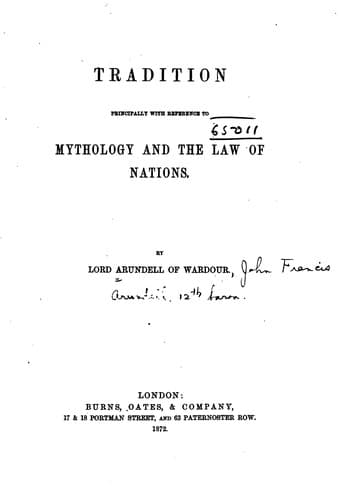
Tradition, Principally with Reference to Mythology and the Law of NationsArundell of Wardour, John Francis Arundell, Baron
Philosophy
Tradition, Principally with Reference to Mythology and the Law of Nations
Arundell of Wardour, John Francis Arundell, Baron
International law; Macdonell, George, 1780-1870; Mythology; Natural law; Tradition (Theology)
Let us now turn to Sir J. Lubbock's theory, as expressed in the
extract above, in which he shows us how marriage by capture would
quite naturally have arisen out of the state of communal marriage. But
if natural, it would have been natural from the commencement, _quid
vetat_? There must then have been a system also in operation from the
commencement, the inevitable tendency of which, by making paternity
distinct and recognisable, would have been to substitute inheritance
through males; and this system, by introducing a more robust posterity,
would rapidly have gained upon the other system. Male inheritance, it
would then appear, commenced and established itself at the outset, and
to the displacement of inheritance through females. How, then, do we
find traces of the latter custom so prevalent? From this point of view
the more instances Sir J. Lubbock accumulates, the more he will excite
our incredulity and surprise.
This theory again, equally with Mr M'Lennan's, supposes mankind
originally in a state of hetairism, in which case it is futile to talk
of tribes and of marriage out of the tribe; for how did they emerge
into this tribal separation out of the state of promiscuity? The
difficulty gets more complicated since, _ex hypothesi_, after emerging
from, they still remain within the tribal limits, in the state of
hetairism. These preliminaries must be settled before the argument can
be carried further.
The usual philosophic formula is, of course, at hand--these changes
must have required an indefinite lapse of ages! Into this swamp we
shall see one philosopher after another disappear, leaving a delusive
light behind him! If we could only, Dante like, recall one of these
philosophers to life, after he has passed into his state of Nirvana,
we would ask, as in this instance, why, supposing the state of
promiscuity, it would require an indefinite lapse of ages to pass from
it, according to the conditions of Sir John Lubbock's argument (_i.e._
to the state of exogamy); considering that, _vide supra_, "it is
obvious that, even under communal marriage, a warrior who had captured,
&c., would claim a peculiar right to her, and, when possible, would set
custom at defiance." Clearly, then, it only required the man and the
opportunity.
APPENDIX TO CHAPTER III.
The view at p. 26 substantially coincides with the lines laid down
by Blackstone (compare Plato; Grote's Plato, iii. 337), which are the
subject of Bentham's attack, and to which the recent contributions of
Sir Henry Maine to our knowledge in these matters would seem to run
counter. Blackstone, "Comm." i. 47, said--
Public-domain text, read in full here on John Shaqi.
Reviews
Reviews
No reviews yet
Be the first to share your thoughts on this work.
Elsewhere in the archive
Join the Discussion
Join the discussion
Sign in to leave a comment or review.
Sign InorCreate an account