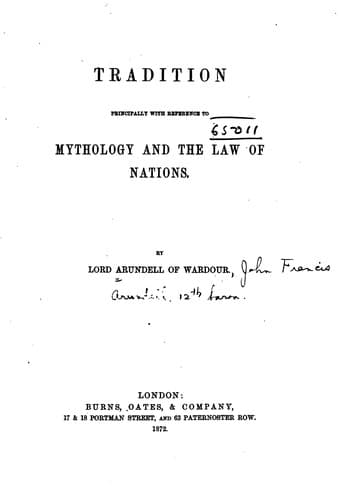
Tradition, Principally with Reference to Mythology and the Law of NationsArundell of Wardour, John Francis Arundell, Baron
Philosophy
Tradition, Principally with Reference to Mythology and the Law of Nations
Arundell of Wardour, John Francis Arundell, Baron
International law; Macdonell, George, 1780-1870; Mythology; Natural law; Tradition (Theology)
"This notion, of an actually existing unconnected state of nature,
is too wild to be seriously admitted: and, besides, it is plainly
contradictory to the revealed accounts of the primitive origin of
mankind and their preservation two thousand years afterwards, both
which were effected by the means of single families. These formed the
first society among themselves, which every day extended its limits;
and when it grew too large to subsist with convenience in that pastoral
state wherein the Patriarchs appear to have lived, it necessarily
subdivided itself by various migrations into more. Afterwards, as
agriculture increased, which employs and can maintain a much greater
number of hands, migrations became less frequent, and various tribes,
which had formerly separated, reunited again, sometimes by compulsion
and conquest, sometimes by accident, and sometimes, perhaps, by
compact.... And this is what we mean by the original contract of
society, which, though perhaps in no instance it has ever been formally
expressed at the first institution of a state, yet, in nature, reason
must always be understood and implied in the very act of associating
together.... When society is once formed, government results, of
course, as necessary to preserve and to keep that society in order ...
unless some superior were constituted ... they would still remain in a
state of nature."
Bentham says of this passage from Blackstone, that "'_society_,' in one
place, means the same thing as a '_state of nature_' does: in another
place, it means the same as '_government_.' Here we are required to
believe there _never was_ such a state as a state of nature: then we
are given to understand there _has been_. In like manner, with respect
to an original contract, we are given to understand that such a thing
never existed, that the notion of it is even ridiculous; at the same
time, that there is no speaking nor stirring without supposing that
there was one."--_Bentham's "Fragment on Government,"_ p. 9 (London,
1823).
The previous and subsequent chapters (ii., xiii.), will be found to
meet these strictures of Bentham, although not originally written with
reference to them.
CHAPTER IV.
_CHRONOLOGY FROM THE POINT OF VIEW OF TRADITION._
To many it may seem a fundamental objection that my theory supposes
a chronology altogether out of keeping with modern discovery; and I
fancy there is a somewhat general impression that modern science has an
historical basis, to which not even the Septuagint chronology can be
made to conform.
This really is not the case; but assuming it to be true, I must still
remark, that if facts of primeval tradition have been established, the
long lapse of ages will only enhance our notions of the persistency of
tradition; or if the lapse of ages is disproved, this conclusion will
be in recognition of a truth to which tradition testifies.
Public-domain text, read in full here on John Shaqi.
Reviews
Reviews
No reviews yet
Be the first to share your thoughts on this work.
Elsewhere in the archive
Join the Discussion
Join the discussion
Sign in to leave a comment or review.
Sign InorCreate an account