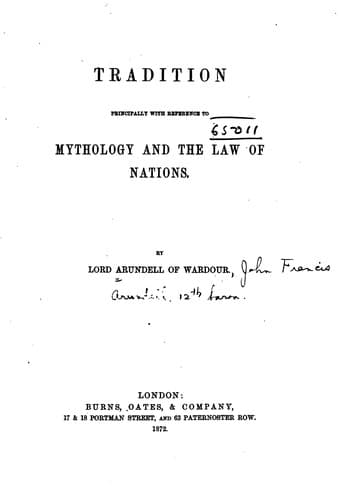
Tradition, Principally with Reference to Mythology and the Law of NationsArundell of Wardour, John Francis Arundell, Baron
Philosophy
Tradition, Principally with Reference to Mythology and the Law of Nations
Arundell of Wardour, John Francis Arundell, Baron
International law; Macdonell, George, 1780-1870; Mythology; Natural law; Tradition (Theology)
I shall now proceed to establish that the strictly historical
testimony, and the direct historical evidence, is strikingly concurrent
in favour of the scriptural chronology, allowing the margin of
difference between the Hebrew and LXX. versions.[48]
[48] "Aucune des trois chronologies bibliques, là ou elles ne
s'accordent pas entre elles, ne s'impose avec une autorite
suffisante soit au fidele, soit au savant. L'Eglise catholique
a laissé le choix libre entre ces chronologies et elles
n'oblige pas même à en adopter une."--_"Le Monde et L'Homme
Primitif selon la Bible," par Mgr. Meignan, Evêque de
Chalons-sur-Marne_, 1869.
With this view I shall successively examine the chronology of the
principal nations whose annals profess to go back to the commencement
of things--the Aryan (including the Indian, the Persian, the Greek, and
the Roman), the Babylonian, the Chinese, Phoenician, and Egyptian.
_Indian Chronology._--There was a time when the Indian (Aryan)
chronology was believed to attain to the most remote antiquity of all,
and this belief was sustained by the apparently irrefragable testimony
of astronomical evidence. Who upholds this evidence now? On this head
I must refer to Cardinal Wiseman's seventh lecture ("On Science and
Revealed Religion"), where the reader will find a clear and careful
_precis_ of the discussion on the subject between Bailly and Delambre,
the _Edinburgh Review_ and Bentley, to which I am not aware that
anything of consequence has to be added.
If, on the other hand, we turn to what I am exclusively directing
my attention--the strict historical investigation--we find that the
cautious inquiries of such men as Sir W. Jones and Heeren concur in
placing the Aryan invasion at the antecedently very probable date, from
the point of view of Scripture, of some 2000 years B.C.
At the present moment the discussion takes the form of philological
inquiry, and into the antiquity (upon internal evidence) of the ancient
Sanscrit literature. In so far, therefore, as it is philological,
it belongs to the indirect argument, which I am now excluding. In
so far as the Sanscrit literature is historical, I have discussed
the testimony which it brings in the preceding chapter. Professor
Rawlinson, however, in his recent "Manual of Ancient History," refuses
to discuss the question, as he does not regard the Maha-Bharata and
Ramayana as "trustworthy sources of history," and commences his
Persian history with the accession of Cyrus, previously to which he
does not consider the Aryan migration and settlement to have been
completed. Apart, then, from the peculiar line of argument to which
I shall presently refer, it would appear that the Indian chronology,
as reconstructed from history and tradition, falls easily within the
lines, not only of the LXX., but of the Hebrew version.
Public-domain text, read in full here on John Shaqi.
Reviews
Reviews
No reviews yet
Be the first to share your thoughts on this work.
Elsewhere in the archive
Join the Discussion
Join the discussion
Sign in to leave a comment or review.
Sign InorCreate an account