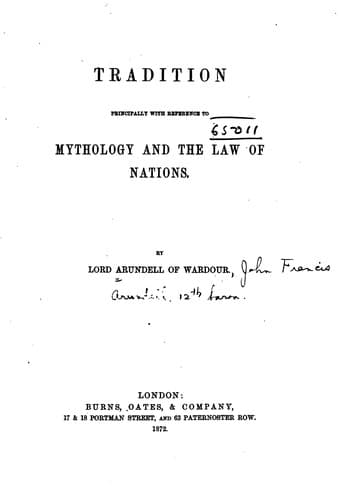
Tradition, Principally with Reference to Mythology and the Law of NationsArundell of Wardour, John Francis Arundell, Baron
Philosophy
Tradition, Principally with Reference to Mythology and the Law of Nations
Arundell of Wardour, John Francis Arundell, Baron
International law; Macdonell, George, 1780-1870; Mythology; Natural law; Tradition (Theology)
|----------------------------------------------
| | Years. | B.C. |
|----------------------------|-----------------|
|Mythical 86 Chaldæans | 34,800 | |
| { 8 Medes | 224 | 2458 |
| {11 [Chaldæans] | (258) | 2234 |
| {49 Chaldæans | 458 | 1976 |
|Historical. { 9 Arab | 245 | 1518 |
| {45 [Assyrian] | 526 | 1273 |
| { 8 [Assyrian] | 122 | 747 |
| { 6 Chaldæans | 87 | 625 |
|----------------------------|----------|------|
| | 36,000 | |
|----------------------------|----------|------|
_Chinese Chronology._--The Chinese, also--though, be it observed,
the Chinese of modern date, according to Klaproth ("Mem. Relatifs. à
l'Asie," i. 405; Klaproth places the commencement of the uncertain
history of China 2637 B.C., the certain history 782 B.C.),[50] in
the first year of our era, but more systematically in the ninth
century--forged a mythological history, which carried the empire back
2,276,000 years (another calculation, 3,276,000). He adds, however,
that the Chinese themselves do not consider the Wai-ki, the authority
for these statements, to be historical.
[50] Bunsen ("Egypt," iii. 405) says, "Systematic Chinese
history and chronology hardly go back as far as the year
2000 B.C., _i.e._ to the reign of Yü (1991)." Yet
upon indirect philological conclusions, he would really
take their history back _beyond the_ Egyptian--iii. p. 379.
"An explanation must be given why it (the Chinese history)
commences at a later period (as above) than Egyptian
chronology; much _later_, indeed, than is generally supposed.
Search must be made in _other quarters than_ the regular
extant chronology for proofs of that _vast antiquity_, which
the numerous _records_ of language _compel_ us to assign to
the origines of the Chinese." This vast antiquity may be
measured by the fact that, _ex hypothesi_, it transcends the
Egyptian, and for the Egyptian in his theory of progress and
development, he requires _at least 20,000 years_ before the
Christian era.
Public-domain text, read in full here on John Shaqi.
Reviews
Reviews
No reviews yet
Be the first to share your thoughts on this work.
Elsewhere in the archive
Join the Discussion
Join the discussion
Sign in to leave a comment or review.
Sign InorCreate an account