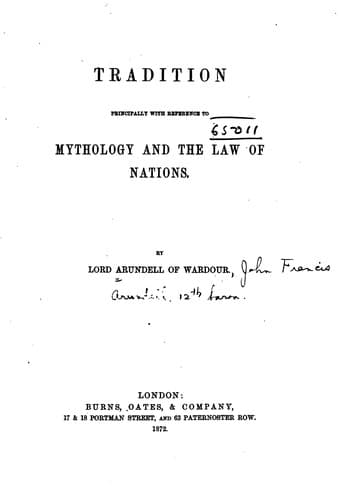
Tradition, Principally with Reference to Mythology and the Law of NationsArundell of Wardour, John Francis Arundell, Baron
Philosophy
Tradition, Principally with Reference to Mythology and the Law of Nations
Arundell of Wardour, John Francis Arundell, Baron
International law; Macdonell, George, 1780-1870; Mythology; Natural law; Tradition (Theology)
Again, if we allow ourselves to be entangled in certain astronomical
disputations, the question may become complicated and confused; but the
astronomical discussion must depend, in the end, upon a point which
history must determine--_i.e._ whether the astronomical knowledge and
observations referred to had come down in primitive tradition, or had
been imported at a later date. Although it need not exclude a belief
in a tradition of primitive knowledge of astronomy, yet the doubt will
ever cause a fatal uncertainty in any calculations, since, if the
knowledge, or the knowledge of the particular observations and facts,
had at any time been imported, they might have calculated back their
eclipses, as has been proved to have been done in India.
Let us then, excluding the purely astronomical calculations, closely
scrutinise the evidence which tradition affords; for if we can discover
tradition of "appearances of rare occurrence, and which are difficult
to calculate, such as many of the planetary conjunctions," they "must,"
as Baron Bunsen observes ("Egypt," iii. p. 389), "either be pure
inventions, or contemporary notations of some extraordinary natural
phenomena." Baron Bunsen proceeds to say:--"One instance that may be
cited is the traditional observation of a conjunction of five planets
(among which the sun and moon are mentioned), on the first day of
Litshin, in the time of Tshuen-hiü, the _second successor of Hoang-ti_.
Suppose this should have been the great conjunction of the three upper
planets which recurs every 794 years and four months, and to which
Kepler first turned his attention in reference to the year of the
nativity of Christ. It took place in the following years.
The one which occurred in historical times was in November, seven years
B.C.; consequently the conjunctions prior to it occurred in--
Yrs. Mos. Dys.
794 4 12
7 10 12
---------------------
786 6 0
794 4 12
---------------------
1580 10 12
And the conjunction in 794 4 12
---------------------
The time of Tshuen-hiü in 2375 2 24
According to the official Chinese tables, as given by Ideler, he
reigned from 2513 B.C. to 2436 B.C.; but the dates vary to the extent
of more than 200 years, and the year 2375 comes within the limits of
these deviations."
Public-domain text, read in full here on John Shaqi.
Reviews
Reviews
No reviews yet
Be the first to share your thoughts on this work.
Elsewhere in the archive
Join the Discussion
Join the discussion
Sign in to leave a comment or review.
Sign InorCreate an account