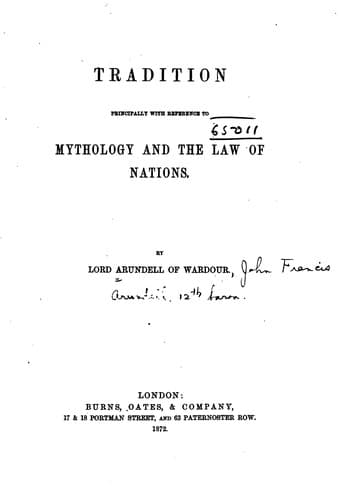
Tradition, Principally with Reference to Mythology and the Law of NationsArundell of Wardour, John Francis Arundell, Baron
Philosophy
Tradition, Principally with Reference to Mythology and the Law of Nations
Arundell of Wardour, John Francis Arundell, Baron
International law; Macdonell, George, 1780-1870; Mythology; Natural law; Tradition (Theology)
Although the testimony of history is definite and decisive as to the
chronology of the world, within the limits of a few hundred years,
there is a general assumption, in all branches of scientific inquiry,
that man must have existed many thousand years beyond the period thus
assigned to him. Lyell speaks of "the vastness of time"[59] required
for his development, and Bunsen, as we have seen, requires twenty
thousand years, at least, between the Deluge and the nativity of
our Lord: and wherefore this discrepancy? Because of a fundamental
assumption--not merely hypothetical for the convenience of inquiry--but
confident and absolute; an assumption which, so far as the argument is
concerned, is the very matter in dispute--that man must have progressed
and developed to the point at which we see him.
[59] "Principles of Geology," tenth edition, 1868, ii. p. 471.
At the same time, the actual chronology cannot be altogether ignored,
and some cognisance must be taken of the facts which history presents
to us; and it is this unfortunate exigency, interrupting the placid
course of development, which not unfrequently lands scientific
inquirers of the first eminence in difficulties from which it will take
an indefinite lapse of time to extricate them; _ex. gra._, Bunsen, in
his "Egypt," iii. 379, says--
"It has been more than once remarked, in the course of this work,
that the _connection between the Chinese and the Egyptians_
belongs, in several of its phases, to the _general history_ of
the world. The Chinese language is the furthest point beyond that
of the formation of the Egyptian language, which represents, as
compared with it, the middle ages of mankind,--viz., the Turanian
and Chamitic stages of development."
The conclusion of philology (_vide_ also Brace's "Ethnology," p. 114)
is, therefore, that the Turanian or Chamitic grew out of the more
inorganic and elementary Chinese.
Now, let us compare Lyell's conclusions with Bunsen's. Lyell equally
believes ("Principles of Geology," ii. 471) "that three or four
thousand years is but a _minute fraction_ of the time required to bring
about such wide divergence from a common parent stock, 'as between' the
Negroes and Greeks and Jews, Mongols and Hindoos, represented on the
Egyptian monuments."
At the same time, he endorses Sir John Lubbock's view, and pronounces,
upon what appears to me very light and insufficient grounds (ii. 479),
that "the theory, therefore, that the savage races have been degraded
from a previous state of civilisation _may be rejected_:" and by
implication that the civilised races have progressed from the savage
state may be affirmed.[60]
Public-domain text, read in full here on John Shaqi.
Reviews
Reviews
No reviews yet
Be the first to share your thoughts on this work.
Elsewhere in the archive
Join the Discussion
Join the discussion
Sign in to leave a comment or review.
Sign InorCreate an account