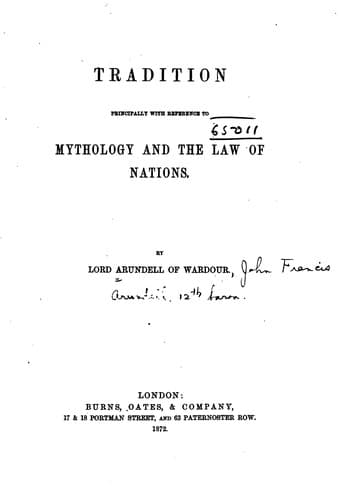
Tradition, Principally with Reference to Mythology and the Law of NationsArundell of Wardour, John Francis Arundell, Baron
Philosophy
Tradition, Principally with Reference to Mythology and the Law of Nations
Arundell of Wardour, John Francis Arundell, Baron
International law; Macdonell, George, 1780-1870; Mythology; Natural law; Tradition (Theology)
It must, I think, be conceded that we have now before us three very
similar accounts of works undertaken with reference to the reclamation
of inundated land. All are undertaken by the first founders of their
respective kingdoms--kingdoms widely separated and inhabited by
people of diverse race--and all, more or less, contemporaneously.
The Egyptians and Kashmerian have points in common as to their mode
of reclamation, whilst the Chinese and Kashmerian have still more in
common with the narrative in Genesis.[57]
[57] I have since found this identical tradition (_vide_ p. 325)
among the Mozca Indians. "Boshicha," it is said, "taught
them _to build and to sow_, formed them _into communities_,
GAVE AN OUTLET TO THE WATERS OF THE GREAT LAKE, &c." This
seems demonstratively to prove, either that the Mozca Indians
(South America) came from China, India, or Egypt--which I have
contended for at p. 266--or else, which makes the argument
I have in hand stronger, they have transmitted an identical
tradition by a different channel.
Four solutions occur to me as possible. Either they were obscure or
perverted traditions of the Deluge, or their works were traditions of
similar works effected by Noah after the Deluge; or these works were
actually carried out upon the precedent and model of similar works
effected by Noah; or they were fortuitous coincidences.
Upon either of the three former conclusions, it will be shown that
traditions of the Deluge, direct or indirect, exist both in Egypt and
China, where it has been so confidently asserted that no tradition
is to be found; and in the latter case, what is more especially to
my purpose, a tradition which brings Yao into relation with Noah and
Hoang-ti.
In conclusion, I must remark that when it is urged that there is no
tradition, or but slight tradition, of the flood in Egypt, we have a
right to reply that there is no country where we should have so little
reason to expect it. If there is any country where we should think
it likely that the reminiscences of the Deluge would be effaced, it
would be in a country periodically subject to inundations, where the
people are annually made familiar with its incidents, and where its
recurrence is not to them a cause of alarm, but a matter of expectation
and joy.[58]
[58] "The Chinese _who migrated before the Deluge (sic)_ have no
reminiscences, any more than the Egyptians, of the great
catastrophe which we know by the name of the Flood of Noah"
(Bunsen's "Egypt," iii. 397). Palmer ("Egypt. Chron.," i. p.
38) says, with reference to a certain date--"This is only for
such as know the true date of the flood, the end of the old
world--an epoch by no means to be named, nor even directly
alluded to, by any Egyptian."
CHAPTER V.
_CHRONOLOGY FROM THE POINT OF VIEW OF SCIENCE._
Public-domain text, read in full here on John Shaqi.
Reviews
Reviews
No reviews yet
Be the first to share your thoughts on this work.
Elsewhere in the archive
Join the Discussion
Join the discussion
Sign in to leave a comment or review.
Sign InorCreate an account