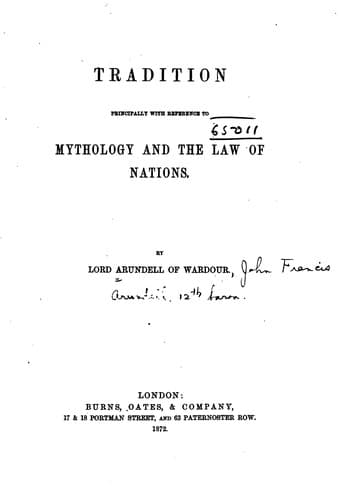
Tradition, Principally with Reference to Mythology and the Law of NationsArundell of Wardour, John Francis Arundell, Baron
Philosophy
Tradition, Principally with Reference to Mythology and the Law of Nations
Arundell of Wardour, John Francis Arundell, Baron
International law; Macdonell, George, 1780-1870; Mythology; Natural law; Tradition (Theology)
This is one instance of the entanglement in which the theory of
progress, pure and simple, from a parent stock will involve us. The
obvious mode of escape would be to deny the unity of the human race,
a conclusion which would at once land us in the darkness of a still
lower abyss, and convert our processes from being scientific in form
and hopeful of result, into empirical and aimless conjectures. For
either the theory is started that the various races of mankind were
created separately, in which case we fly into the face of the only
account we have of creation, and also of the multiform testimonies
which history and science bring to attest this truth, and we, moreover,
debar ourselves from falling back upon any uniform theory applicable to
the whole human race; or if, without advertence to creation, we suppose
mankind to have been variously developed, here again we shall equally
find ourselves cut off from the application of any uniform historical
theory, equally unable to account for or to exclude the testimony of
history, and in the end reduced to the evidences, whatever they may be
worth, of certain real or fancied analogies.[61] At this point, the
historical inquiry will be virtually abandoned, and the records of the
past merged in the phenomena of life, will be considered only in the
light of some pantheistic or materialistic theory, or, so far as it is
distinguishable, of some theory of evolution.
[61] The following passage from M. A. Bastian's article in _The
Academy_, June 15, 1871, "On the People of India," seems
to me to afford an illustration in point--"The natural
system becomes an indispensable necessity in every science,
so soon as it is clearly seen that the question is not of
classification, but of observation of, and insight into,
law. Classification was long held to be the sole end,
instead of being merely or mainly the means of study. As,
in this respect, systematic botany gave place to vegetable
physiology, so, in like manner, ethnology will have to look
upon its classification of race--with which the school books
hitherto have been almost exclusively occupied--as merely a
preliminary step towards a physiology of mankind, and to _a
science of the laws_ which _govern its spiritual growth_."
Now, if no physiology of mankind, in the sense here intended,
can be traced, and if "the science of the laws which govern
its spiritual growth" (_vide infra_, an exposition of Mr
Baring Gould's theory) has come to no definite conclusion,
then the only result, as far as science is concerned, will
have been the revolutionising of its classifications, and the
classifications of the different races of men (and, in so far
as they have been accurately ascertained, their confusion will
be matter of regret) is the legitimate and ultimate end of
ethnology under normal conditions.
Public-domain text, read in full here on John Shaqi.
Reviews
Reviews
No reviews yet
Be the first to share your thoughts on this work.
Elsewhere in the archive
Join the Discussion
Join the discussion
Sign in to leave a comment or review.
Sign InorCreate an account