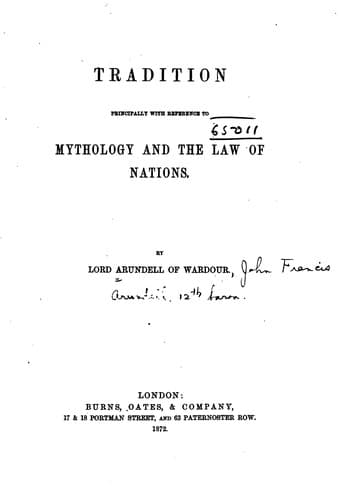
Tradition, Principally with Reference to Mythology and the Law of NationsArundell of Wardour, John Francis Arundell, Baron
Philosophy
Tradition, Principally with Reference to Mythology and the Law of Nations
Arundell of Wardour, John Francis Arundell, Baron
International law; Macdonell, George, 1780-1870; Mythology; Natural law; Tradition (Theology)
I am no longer concerned with any of these theories the moment they
discard the historical element; and I shall, accordingly, return to the
theory of Sir John Lubbock, which is honestly based upon it.
When all is said, I cannot make out that Sir John adduces any argument
in favour of the antiquity of the human race which does not resolve
itself into the contrast between our civilisation and the degradation
of savages; and that the time which must have elapsed to bring about
this transformation is measured by the fact that the negro, of the
"true Nigritian stamp," appears upon the Egyptian monuments, at
least as far back as B.C. 2400. "Historians, philologists,
and physiologists have alike admitted that the short period allowed
in Archbishop Usher's chronology could hardly be reconciled with
the history of some Eastern nations, and that it did not leave room
_for the development either of_ the different languages or of the
numerous physical peculiarities by which various races of men are
distinguished."[62] As no facts in the history of Eastern nations are
adduced, I shall consider that this part of the argument has been
sufficiently disposed of in the preceding chapters, and if they had
been adduced, I venture to think that they would have been interpreted
by the latter part of the sentence, and would have been incompatible
with the chronology, only because they did not allow sufficient time
"for the development," &c. Of this sort of fact, I admit, nothing
stronger can be adduced than the case of the negro on the Egyptian
monuments, only I wish to direct attention to the different aspect
these facts will bear when the theory of progress is not assumed as
an infallible proposition. Moreover, as Mr Poole, whom Sir J. Lubbock
very candidly quotes, points out, in the interval between this and
2400 B.C. we do not find "the least change in the negro or
the Arab; and even the type which seems to be intermediate between
them, is virtually as unaltered. Those who consider that length of
time can change a type of man, will do well to consider the fact
that three thousand years give no ratio on which a calculation could
be founded." So that if Arch. Usher had expanded his chronology so
as to take in the twenty thousand years Bunsen requires, it really
would not appreciably have affected the argument. Sir J. Lubbock,
indeed, says (p. 477)--"I am, however, not aware that it is supposed
by any school of ethnologists that 'time' alone, without a change of
external conditions, will produce an alteration of type." "Let us,"
he continues, "turn now to the instances relied on by Mr Crawford.
The millions, he says, of African negroes that have, during three
centuries, been transported to the New World and its islands, are the
same in colour as the present inhabitants of the parent country of
their forefathers. The Creole Spaniards ... are as fair as the people
of Arragon and Andalusia. The pure Dutch Creole colonists of the Cape
Public-domain text, read in full here on John Shaqi.
Reviews
Reviews
No reviews yet
Be the first to share your thoughts on this work.
Elsewhere in the archive
Join the Discussion
Join the discussion
Sign in to leave a comment or review.
Sign InorCreate an account