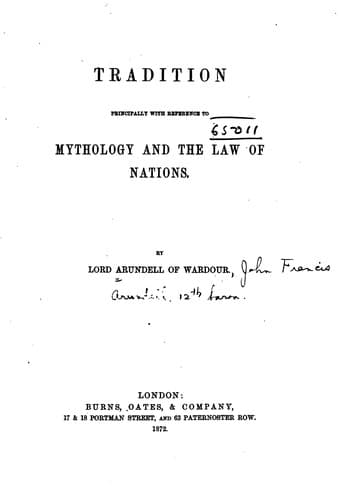
Tradition, Principally with Reference to Mythology and the Law of NationsArundell of Wardour, John Francis Arundell, Baron
Philosophy
Tradition, Principally with Reference to Mythology and the Law of Nations
Arundell of Wardour, John Francis Arundell, Baron
International law; Macdonell, George, 1780-1870; Mythology; Natural law; Tradition (Theology)
of Good Hope, after dwelling two centuries among black Caffres and
yellow Hottentots, do not differ in colour from the people of Holland."
[The strongest case is, perhaps, that of the American Indians, who do
not vary from a uniform copper colour in north or south--in Canada
or on the line.][63] In these instances, Sir J. Lubbock says:--"We
have great change of circumstances, but a very insufficient lapse of
time, and, in fact, there is no well authenticated case [he does not,
however, advert to the case of the Indians, which seems to satisfy both
conditions] in which these two requisites are united," ... and adds,
"there is already a marked difference between the English of Europe and
the English of America;" but is full allowance made here for admixture
of race? and, also, is his instance to the point? Is not the difficulty
rather that, whereas climate, food, change of circumstances have (for,
I think, the balance of the argument is on that side), in many ways,
modified other races (though whether to the extent of destroying the
characteristic type, may be open to question), the negro has resisted
these influences, and has remained the same negro that we find him 2400
B.C.? Consider that it is only a question of degree, and that
it is merely true that the negro has resisted these influences more
persistently than other races.[64] Still the contrast is not the less
startling when we find the negro in the same relative position, and
with the same stamp of inferiority, that we find indelibly impressed
upon him four thousand years ago? It is a case which neither the theory
of progress, nor the theory of degeneracy, seems to touch.
[62] Sir J. Lubbock's "Prehistoric Times," p. 313.
[63] It has almost passed into a proverb, says Morton--who is among
those who know the Americans best--that he who has seen one
Indian tribe has seen them all, so closely do the individuals
of this race resemble each other, whatever may be the variety
or the extent of the countries they inhabit." Reusch's "La
Bible et la Nature," _vide_ also Card. Wiseman's "Lect. on
Science and Rev. Rel." lect. iv., _vide_, however, Reusch,
p. 498, where "a remarkable difference in the cranium" is
noticed, "sometimes approaching the Malay, sometimes the
Mongol shape."
Public-domain text, read in full here on John Shaqi.
Reviews
Reviews
No reviews yet
Be the first to share your thoughts on this work.
Elsewhere in the archive
Join the Discussion
Join the discussion
Sign in to leave a comment or review.
Sign InorCreate an account