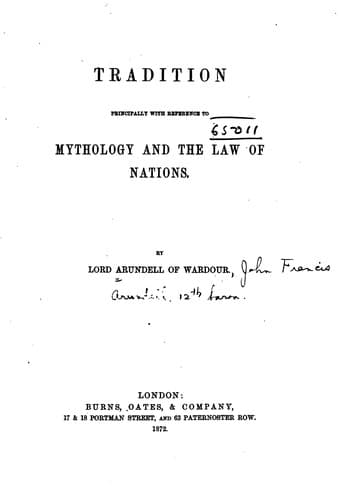
Tradition, Principally with Reference to Mythology and the Law of NationsArundell of Wardour, John Francis Arundell, Baron
Philosophy
Tradition, Principally with Reference to Mythology and the Law of Nations
Arundell of Wardour, John Francis Arundell, Baron
International law; Macdonell, George, 1780-1870; Mythology; Natural law; Tradition (Theology)
On the other hand, blackness, from the commencement, has been
associated with evil. To this it may be replied that this is the
sentiment merely of the white races--a natural prejudice of colour, an
_ex parte_ deduction; and to this argument, if such is the view really
taken by the black races, and if no consciousness can be detected of
their degradation amongst themselves, I see no other reply than this,
That since, _ex hypothesi_, they are black because they are cursed,
the tradition of this curse would be more naturally preserved by the
white races than by the black. But is there no consciousness of this
inferiority in the true negro? Without looking at the matter from
the same point of view, I may appeal to Captain Burton's statements
on this point as to a fully competent, if not the highest, authority
that can be quoted on points of African travel. In the first place,
he notices "the confusion of the mixed and the mulatto with the
full-blooded negro. By the latter word I understand the various tribes
of intertropical Africa, unmixed with European or Asiatic blood"
("Dahome," ii. 187); and p. 193, "I have elsewhere given reasons for
suspecting, in the great Kafir family, a considerable mixture of
Arab, Persian, and other Asiatic blood:" and as to the particular
point in question, he says (p. 200), "The negro will obey a white man
more readily than a mulatto, and a mulatto rather than one of his own
colour. He never thinks of claiming equality with the Aryan race except
when taught. At Whydat, the French missionaries remark that their
scholars always translate 'white and black by master and slave.'" P.
189, "One of Mr Prichard's few good generalisations is, that as a rule
the darker and dingier the African tribe, the more degraded is its
organisation."[65] I find a very similar testimony in Crawford's "Hist.
of the Indian Archipelago," i. 18. He says, "The brown and negro races
of the Archipelago may be considered to present, in their physical and
moral characters, a complete parallel with the white and negro races in
the western world. The first has always displayed as great a relative
superiority over the second, as the race of white men have done over
the negroes of the west." Yet at p. 20 he says, "The Javanese, who live
most comfortably, are among the darkest people in the Archipelago, the
wretched Dyaks, or cannibals of Borneo, among the fairest." It must
be noted, however, that the Javanese have also preserved something of
primitive tradition--_e.g._ their marriage ceremony. And, moreover,
it is not at all essential to the argument to prove that the negroes
are the _most degraded_ race. Let it be said that they have had their
curse, and that the sign of the curse is in their blackness--this is
merely equivalent to saying that they are cursed _pro tanto_; but it by
no means follows that other races have not fallen to lower depths, and
incurred a deeper reprobation.[66]
Public-domain text, read in full here on John Shaqi.
Reviews
Reviews
No reviews yet
Be the first to share your thoughts on this work.
Elsewhere in the archive
Join the Discussion
Join the discussion
Sign in to leave a comment or review.
Sign InorCreate an account