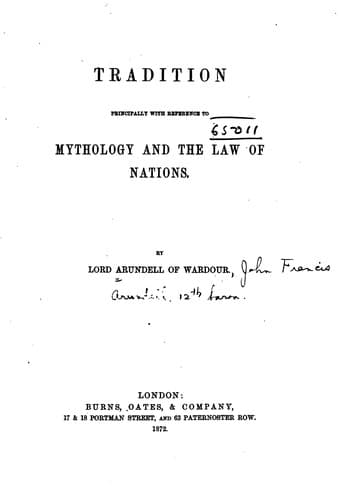
Tradition, Principally with Reference to Mythology and the Law of NationsArundell of Wardour, John Francis Arundell, Baron
Philosophy
Tradition, Principally with Reference to Mythology and the Law of Nations
Arundell of Wardour, John Francis Arundell, Baron
International law; Macdonell, George, 1780-1870; Mythology; Natural law; Tradition (Theology)
[65] Captain Burton (ii. 165) also quotes a Catholic and a
Protestant missionary as to this point. M. Wallon says, "Avec
leur tendance à nous considérer comme réellement supérieurs à
eux, et leur croyance que cette supériorité nous est acquise
par celle de notre Dieu, ils renonceraient bientôt aux leurs
idoles pour adorer celui qui nous leur prions de connaître."
Mr Dawson says, "Fetish has been strengthened by the white
man, whom the ignorant blacks would not scruple to call a god
if he could avoid death."
Assuming the identity of Bacchus and Noah, it is a striking
circumstance, from this point of view, that the name of
_Bacchus_, among the Phoenicians, was a synonymous term for
mourning.--_Vide Hesychius in Bryant's "Mythology,"_ ii. 335;
_vide also the verses of Theocritus_. Comp. p. 247, _note_
(Boulanger).
[66] Perhaps Captain Burton's phrase (ii. 178), "the _arrested_
physical development of the negro," may, if extended to his
mental development, exactly hit the truth, the standard being
fixed by the age at which we conceive the boy Chanaan's
development to have been _arrested_.--Comp. _Wallace, infra_,
p. 91; comp. 217.
Among the Sioux Indians, and in the isle of Tonga (Oceanica), I find
trace of the tradition of blackness as a curse, and I should think
it likely that other instances might be discovered. The former (the
Sioux), in their reminiscences of the Deluge, relate, "The water
remained on the earth only two days (for the two months during which
the Scripture says it was at its height), at the expiration of which
the Master of Life, seeing that they had need of fire, sent it them by
a white crow, which, stopping to devour carrion, allowed the fire to be
extinguished. He returned to heaven to seek it. The Great Spirit drove
it away, and punished it by _striking it black_."--"_Annales de la
Prop. de la Foi_," l. iv. 537; Gainet, i. 211.
In Tonga, the tradition is connected with this history of Cain:--
"The god Tangaloa,[67] who first inhabited this earth, is this
Adam. He had two sons, who went to live at Boloton.... The younger
was very clever. Tonbo (the eldest) was very different; he did
nothing but walk about, sleep, and covet the works of his brother.
One day he met his brother out walking, and knocked him down. Then
their father arrived at Boloton, and in great anger said, 'Why
has thou killed thy brother. Fly, wretched man; fly. _Your race
shall be black_, and your soul depraved; you shall labour without
success. Begone; you shall not go to the land of your brother, but
your brother shall come sometimes to trade with you.' And he said
to the family of the victim, 'Go towards the great land; your skin
shall be white; you shall excel in all good things.'"--_Gainet_, i.
93.[68]
[67] "Annales de Philos. Chret.," t. xiii. p. 235.
Public-domain text, read in full here on John Shaqi.
Reviews
Reviews
No reviews yet
Be the first to share your thoughts on this work.
Elsewhere in the archive
Join the Discussion
Join the discussion
Sign in to leave a comment or review.
Sign InorCreate an account