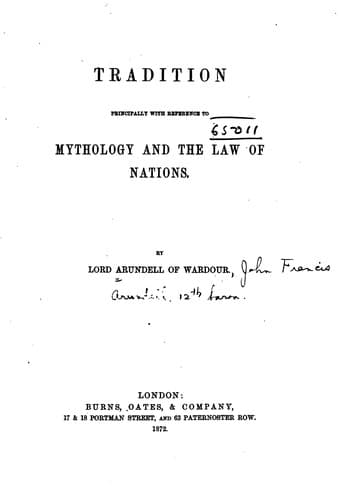
Tradition, Principally with Reference to Mythology and the Law of NationsArundell of Wardour, John Francis Arundell, Baron
Philosophy
Tradition, Principally with Reference to Mythology and the Law of Nations
Arundell of Wardour, John Francis Arundell, Baron
International law; Macdonell, George, 1780-1870; Mythology; Natural law; Tradition (Theology)
The following conclusion of Mr Wallace also exactly coincides with De
Maistre's view.
Lyell, in his "Principles of Geology" (ii. 471) says--
"Wallace suggests that at some former period man's corporeal frame
must have been _more pliant and variable_ than _it is now_; for,
according to the observed rate of fluctuation in modern times,
scarcely any conceivable lapse of ages would suffice to give rise
to such an amount of differentiation. He therefore concludes, that
when first the _mental_ and _moral_ qualities of man acquired
predominance, his bodily frame _ceased to vary_."
But, although science in its own way may arrive at approximations to
the truth, yet, if the traditional solution be true, assuredly it is
not a solution which will be reached by any merely scientific process;
and therefore, if it should be the truth, the ethnological difficulty
will remain an enigma and embarrassment to the learned in all time to
come.
CHAPTER VI.
_PALMER ON EGYPTIAN CHRONOLOGY._
Having probed the chronologies of India, Babylonia, Phoenicia,[75]
China, &c., and having found that one and all, when touched with the
talisman of history, shrink within the limits of the Septuagint, and
even of the Hebrew text, we come, perforce, to the conclusion, that
there is one nation, and one only, which presents a _primâ facie_
antiquity irreconcileable with Holy Writ--viz. Egypt.
[75] _Vide ante_ ch. iv.; and also _vide_ Palmer, i. 49.
This impression is sustained by the knowledge, somewhat indefinite
and in something disturbed, that the Egyptian tradition had always
attributed a fabulous antiquity to the dynasties of its kings, and
that these dynasties have been marvellously resuscitated through the
discovery which has enabled us to decipher the inscriptions on their
tombs and monuments.
My reader need not fear, however, lest I should plunge him into the
chaos of hieroglyphics; not, indeed, that much has not been rescued
from the abyss, and that there is not good expectation of more to come,
but when once it is established, as we may now consider to be the case,
that many of these dynasties were cotemporaneous, and not successive,
an uncertainty is introduced which again reduces the chronology to
primitive chaos, although floating objects in it, the _débris_ of
tombs and dynasties, remain clearly distinguishable, and, in point of
fact, have been perfectly identified. If we had no other evidence,
I should feel irresistibly drawn to the dictum of M. Mariette (ap.
Mgr. Meignan, "L'Homme Primitif," p. 391), "Le plus grand de tous les
obstacles à l'établissement d'une chronologie égyptienne regulière,
c'est que les Egyptiens eux-mêmes n'ont jamais eu de chronologie."
I shall, on the contrary, from another point of view, attempt to show,
not only that they had a chronology, but that this chronology has
actually been re-discovered and re-constituted.
Public-domain text, read in full here on John Shaqi.
Reviews
Reviews
No reviews yet
Be the first to share your thoughts on this work.
Elsewhere in the archive
Join the Discussion
Join the discussion
Sign in to leave a comment or review.
Sign InorCreate an account