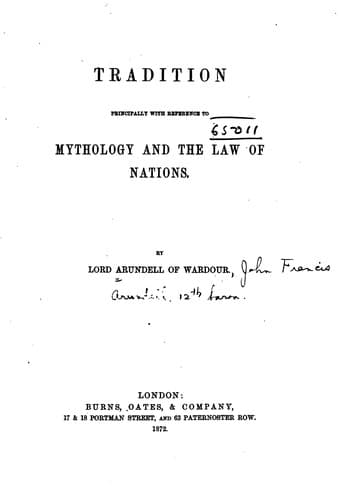
Tradition, Principally with Reference to Mythology and the Law of NationsArundell of Wardour, John Francis Arundell, Baron
Philosophy
Tradition, Principally with Reference to Mythology and the Law of Nations
Arundell of Wardour, John Francis Arundell, Baron
International law; Macdonell, George, 1780-1870; Mythology; Natural law; Tradition (Theology)
It is true, then, that the curse of blackness is not recorded, but
the distribution of the races is at least implied: Deut. xxxii. 8,
"_When the Most High divided the nations, when He separated the sons
of Adam_, he appointed the bounds of people according to the number
of the children of Israel;" and Acts xvii. 26, "And hath made of one
all mankind, to dwell upon the _whole face_ of the earth, _determining
appointed times_, and _the limits_ of _their habitation_." (The Prot.
version translates, "Having appointed the _predetermined seasons_ and
_boundaries of_ their dwellings." _Vide_ Hales's Chron., i. 351, who
adds that this was conformable to their own allegory "that Chronos, the
god of time, or Saturn, divided the universe among his three sons.")[74]
[74] _Vide_ also ch. x., p. 239. The tradition that Phoroneus,
"the father of mankind," distributed the nations over the
earth, _idem nationes distribuit_.
If, then, the different races of mankind, according to their merits or
demerits, were apportioned to, or miraculously directed or impelled
to, respective portions of the earth, which necessarily superinduced
certain effects, is not the curse as apparent in its indirect operation
as it would have been in its suddenness and directness?
This consideration must, I think, bring those who raise scriptural
difficulties against the theory to the admission that blackness was a
sign of inferiority, and that certain races were either smitten with,
or were predestined to, in consequence of culpability, this degradation.
This, I admit, is no reply to those who argue from the evidence of the
Egyptian monuments. But the evidence from the monuments, so far from
embarrassing my conclusion, seems absolutely to enforce it. If, indeed,
the evidence from the monuments did not stare one in the face, we might
fall back upon the line of argument which I have just indicated, and
whilst recognising in their blackness the operation of a curse, trace
it in the lapse of centuries and the influences of the torrid zone. But
they are recorded as being black on the earliest monuments known to us,
and within a few centuries of the Deluge. The conclusion, therefore,
seems inevitable, that they were so from the commencement, which
exactly hits in with the tradition of the curse of Canaan.
Such, from his own point of view, is the conclusion of Sir J. Lubbock
("Prehistoric Times," p. 478)--
"If there is any truth in this view of the subject (p. 478), it
will necessarily follow that the principal varieties of man are of
great antiquity, and, in fact, go back almost to the very origin
of the human race. We may then cease to wonder that the earliest
paintings on Egyptian tombs represent so accurately several various
varieties still existing in those regions, and that the Engis
skull, probably the most ancient yet found in Europe, so closely
resembles many that may be seen even at the present day."
Public-domain text, read in full here on John Shaqi.
Reviews
Reviews
No reviews yet
Be the first to share your thoughts on this work.
Elsewhere in the archive
Join the Discussion
Join the discussion
Sign in to leave a comment or review.
Sign InorCreate an account