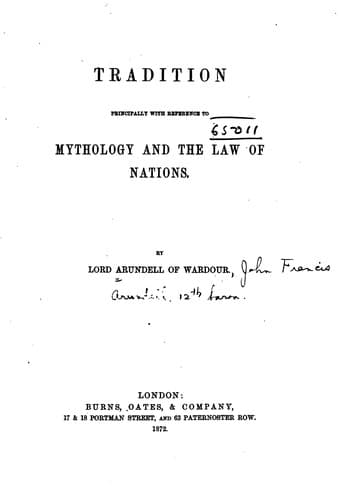
Tradition, Principally with Reference to Mythology and the Law of NationsArundell of Wardour, John Francis Arundell, Baron
Philosophy
Tradition, Principally with Reference to Mythology and the Law of Nations
Arundell of Wardour, John Francis Arundell, Baron
International law; Macdonell, George, 1780-1870; Mythology; Natural law; Tradition (Theology)
In the somewhat lengthened extract which I have made (_sup._ p. 94)
from Bunsen, _four_ figures (3984, 217, 443, and 184) will have struck
the eye, which baffle even Bunsen's penetration, and only make twice
confounded what was confused before. But what if these four figures
should all be accounted for? and, when accounted for, fitted into the
chronology so as to be in keeping, not only with the other figures of
the Chronicle, but also with the systems of Manetho and Eratosthenes,
as exactly as "the key fits the wards of the lock?" (_vide infra_, p.
332), will not the matter begin to wear a different aspect? When the
figures are shown to be imbedded in all the different systems which
have been transmitted to us, will it then be said that the figures
"are evidently borrowed from Eusebius?" But, in fact, it is also
demonstrated by internal evidence that the Chronicle, as we have it,
must be referred to the date 305 B.C.
This, then, is how the argument stands; but it is a matter of some
difficulty to compass Mr Palmer's elaborate argument, and I cannot
attempt to do more than to indicate its most salient points.
Premising that the Sothic cycle (a period of 1461 vague, or 1460 fixed
sidereal years) was connected by the Egyptians with their recurring
periods of transformation and renovation ("common to the mythologies
of Egypt and India"), and also that two such periods (1461 × 2) = 2922
corresponded with the antediluvian period, or rather with the sum
of the lives or reigns of the antediluvian patriarchs, inclusive of
survivors of the Deluge, with something added in order to throw the
whole into cyclical form, all which is shown in detail in "Egyptian
Chronicles," i. 23-37, I may now proceed to Mr Palmer's analysis of
the scheme of the Old Chronicle, which is thus given by Syncellus,
"probably from the Manetho of Africanus" (Palmer's "Egypt. Chron.," i.
7):--
"There is extant among the Egyptians a certain Old Chronicle,
the source, I suppose, which led Manetho astray, exhibiting xxx
dynasties and again cxiii generations, with an infinite space of
time (not the same either as that of Manetho), viz. three myriads,
six thousand five hundred and twenty-five years--1st, Of the
Aeritæ; 2dly, Of the Mestræans; and, 3dly, Of the Egyptians,--being
word for word as follows:--
[Dynasty I. to XV. inclusive of the chronicle of the gods]:--
Time of Phtha there is _none_, as he shines equally by
night and by day [but all generations being from him]
[First dynasty] [Greek: Hêlios] [_i.e._ Ra, the sun-god],
son of Phtha, reigned three myriads of years, 30,000
Then [Dynasty II. to XIV. inclusive, and generations
II. to XIV. inclusive] [Greek: Kronos] [or [Greek:
Chronos], _i.e._ Seb], and all the other xii
gods [who are the Aeritæ perhaps of Eusebius and
Africanus], reigned years 3984
Public-domain text, read in full here on John Shaqi.
Reviews
Reviews
No reviews yet
Be the first to share your thoughts on this work.
Elsewhere in the archive
Join the Discussion
Join the discussion
Sign in to leave a comment or review.
Sign InorCreate an account