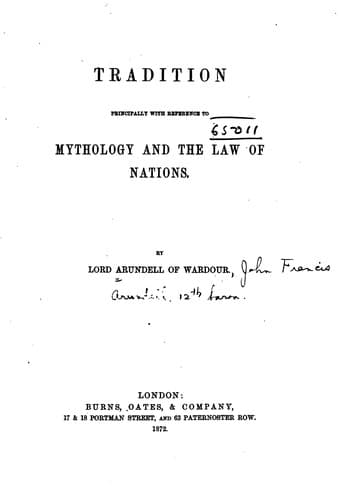
Tradition, Principally with Reference to Mythology and the Law of NationsArundell of Wardour, John Francis Arundell, Baron
Philosophy
Tradition, Principally with Reference to Mythology and the Law of Nations
Arundell of Wardour, John Francis Arundell, Baron
International law; Macdonell, George, 1780-1870; Mythology; Natural law; Tradition (Theology)
"I assert, in the first instance (there being nothing whatever
to the contrary), that we have the Old Chronicle in a _perfectly
genuine form, i.e._ in the text of Syncellus and Africanus, but
by no means in Bunsen; and further, that it really is, and they
from whom we have it _tell us it was_, the oldest Greco-Egyptian
writing of the kind current in the time of Africanus.... Bunsen
pronounces the Old Chronicle to be the compilation of a Jewish or
Christian impostor of the third century ('Eusebius appearing on all
occasions as the authority,' &c.) In the _Old Chronicle_, as given
by Syncellus and Africanus, there is _nothing whatever_ borrowed
from Eusebius; but Eusebius has borrowed from and altered the Old
Chronicle, so as to suit his own sacred chronology. The 'Book of
Sothis,' too, has worked up and altered the Old Chronicle, with
which it is by no means to be identified.... But I deal with three
so-called Manethos--viz. (1.) the original Manetho of Josephus and
Eratosthenes, who had only twenty-three historical dynasties of
his total of thirty dynasties (the Old Chronicle, from which he
took the number of thirty, having twenty-nine historical and one
[that of the sun god] unhistorical); (2.) the Manetho of Ptolemy
of Mendes, which is the Manetho of Africanus, who has thirty-one
dynasties, all pretending to be historical; and, lastly, the
Manetho of the 'Book of Sothis,' used by Anianus and Panadorus
(to which last alone Bunsen's ... mention of 'fifteen dynasties
of the Dog-star' refers).... If any figures in the Manetho of the
'Book of Sothis' of the fifth century A.D., are borrowed
from Eusebius, there is nothing in this, Eusebius himself having
used and altered the Old Chronicle before, just as the author of
the Book of Sothis or Anianus may have used Eusebius and the old
chronicle. But I am not now dealing with the question of fact,
whether Eusebius' figures were so followed or not.... When Bunsen
says, 'Perhaps it may not be mere accident that the figures 3984
agrees,' &c.; he should have said rather that some 'chronographers'
'agree' 'with it,' and perhaps so agree not by accident. I do
not remember whether any one, or who in particular, of modern
chronographers agree with it; but certainly if any do, it is _quite
by accident_. The number 3984, as given by the Old Chronicle to
Chronos and the other twelve gods, has no relation whatever to any
reckoning of the year of the world to Christ; and a chronologer
might as well adapt his sum of years from the Creation to Christ,
or to any other fanciful number, as to this. The truth is, that
with the shorter numbers of the Vulgate, many chronologers have
made out sums of about four thousand years, some rather more, some
less."
Public-domain text, read in full here on John Shaqi.
Reviews
Reviews
No reviews yet
Be the first to share your thoughts on this work.
Elsewhere in the archive
Join the Discussion
Join the discussion
Sign in to leave a comment or review.
Sign InorCreate an account