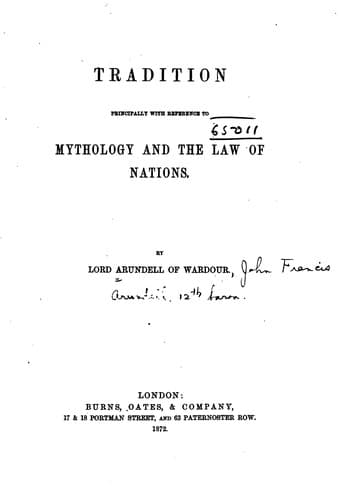
Tradition, Principally with Reference to Mythology and the Law of NationsArundell of Wardour, John Francis Arundell, Baron
Philosophy
Tradition, Principally with Reference to Mythology and the Law of Nations
Arundell of Wardour, John Francis Arundell, Baron
International law; Macdonell, George, 1780-1870; Mythology; Natural law; Tradition (Theology)
"To what Sothic cycle are these 443 years or xv generations said
to belong?" [for there was the doubt whether there was any _real_
Sothic cycle at all.] "For a Sothic cycle is not merely a space
of 1461 Egyptian years, but it is that particular space of 1461
such years, and that only, which begins from the conjunction
of the movable new year or Thoth, with the heliacal rising of
Sirius, fixed to 20th July of our Gregorian calendar for that part
of Egypt which is just above Memphis.... For the author of a
chronicle ending with Nectanebo, or at any date between the Sothic
epochs, 20th July B.C. 1322 (the known commencement of a cycle),
and 20th July A.D. 139, 'the Sothic cycle,' could only mean the
cycle _actually_ current" [_i.e._ B.C. 1322 to A.D. 139 = 1461]....
"After this discovery, if the perception of a truism can be called
a discovery, it followed naturally to observe further that in
constructing a fanciful scheme ... ending at any other date than a
true cyclical epoch, the first operation ... must be to _cut off
all those years of the true current cycle_ which were yet to run
out, below the date fixed upon, and to throw them back so that
they might be reckoned _as past_ instead of being looked forward
to as future. This, then, was what the author of the Old Chronicle
had done; and, with an ironical humour common among the Egyptians,
he had told his readers to their faces the nature of his trick,
ticketing and labelling the key to it (the 443 years) and tying it
in the lock, or rather leaving it in the lock itself." Counting,
then, back 139 years of the 443 "from the 20th July A.D. 139 to
20th July B.C. 1, and 304 more from 20th July B.C. 1, we come to
20th July in 305 B.C. (if the years be fixed, sidereal, or solar
years), or to 8th November 305, if they be (as they really are)
vague Egyptian years" (305 B.C. being the year in which Ptolemy
Lagi assumed the crown).
[For the discrepancy between this date and the conquest of Ochus, "at
which the series of the Chronicle ostensibly ends," _vide_ "Egypt.
Chron.," p. xxiv.]
Let the reader now return to the scheme of the chronicle (_sup._ p.
97). The analysis of the whole sum, 36,525 years, gives 30,000 years
(to the sun), + 3984 (to xiii gods), + 217 (to viii demigods), + 443
(to the Sothic cycle), + 1881 to kings from Menes to Nectanebo (the
last native sovereign).
So far we have only 1881 years, corresponding to an historical period,
+ 443 of the cycle thrown up. It has been previously noted, however,
that 2922 (two Sothic cycles) correspond to the antediluvian and
patriarchal period (i. 37). The intricate part of the scrutiny will
be found in the discrimination of the 2922 years (which, with 217 +
1881, make up the sequence of human time, A.M., to Nectanebo) from the
figures 3984 years in the analysis above.
Public-domain text, read in full here on John Shaqi.
Reviews
Reviews
No reviews yet
Be the first to share your thoughts on this work.
Elsewhere in the archive
Join the Discussion
Join the discussion
Sign in to leave a comment or review.
Sign InorCreate an account