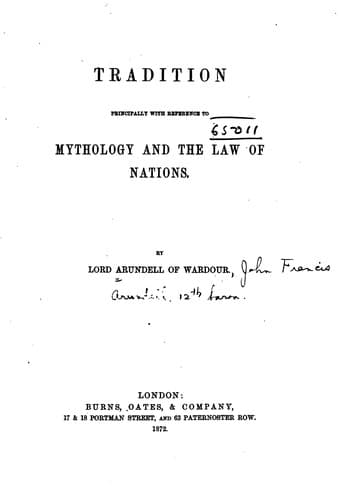
Tradition, Principally with Reference to Mythology and the Law of NationsArundell of Wardour, John Francis Arundell, Baron
Philosophy
Tradition, Principally with Reference to Mythology and the Law of Nations
Arundell of Wardour, John Francis Arundell, Baron
International law; Macdonell, George, 1780-1870; Mythology; Natural law; Tradition (Theology)
For the full and scientific discrimination, I must refer the reader to
"Egyptian Chronicles," i. 17; but for a simple demonstration, we may
take the historical figures as above--viz. 2922 + 217 + 1881, added to
the figures thrown in to complete the cycle (_vide infra_), viz. 341 +
483, all which figures = 5844, and deduct them from the whole cyclical
number thus--
36,525
5,844
------
30,681
Now, reverting to the scheme of the Chronicle, we shall see the round
number 30,000 years (being as it were an Egyptian month, in thousands
of years instead of days) apportioned off to the sun-god. To obtain
this round number, the fractional number 681 would have to be detached,
and there being at hand the cyclical number 2922 years (two perfect
Sothic cycles), any number in reason of fractional remainders might
be added to it, since with the symmetrical nucleus, the agglomeration
would always be recognisable by the initiated, _i.e._ by the priests.
The 681 years were therefore added to 2922, and also the 341 fictitious
years ("to make time from the beginning to run in the form of Sothic
cycles") were added, because _there_ they would cause no confusion;
"whereas if they had been added to the 217 years of the demigods, no
one could any longer have distinguished the original fraction."
We thus collect, therefore, those various figures into the sum which
was the figure of difficulty--viz. 3984 (681 + 2922 + 341 + 40), the
_forty_ years included having merely reference to the point at which
the current Sothic cycle was thrown up--being the years intervening
between the flight of Nectanebo in B.C. 345, and the coronation of
Ptolemy Lagi in B.C. 305.
Upon his own method, based upon Josephus, who follows in the main
the Septuagint ("on a principle of compromise such as all readers,
_whatever_ may be their system, may agree in accepting provisionally,
and as an approximation"), Mr Palmer (i. 22-29) brings the Scripture
A.M. to B.C. 1, to a synchronism of "five years four months" and some
days, with the Egyptian computation.
But the same key is made to unlock all the systems of Egyptian
chronology, and in the course of his two volumes of close and learned
investigation, Mr Palmer demonstrates that "Manetho, Eratosthenes,
Ptolemy of Mendes, Diodorus, Josephus, Africanus, Eusebius, Anianus,
Panodorus, and Syncellus, have, either of themselves or by following
others, transferred dynasties, generations, and years of the gods and
demigods of the Chronicle, and even fifteen generations of Ptolemies
and Cæsars, as yet unborn at the date of the Chronicle, to kings after
Menes."
Let the above scheme of the Chronicle be compared, for instance, with
the scheme of Diogenes Laertius (which Mr Palmer conjectures, upon
intrinsic evidence, to have been transmitted through Aristotle).
Public-domain text, read in full here on John Shaqi.
Reviews
Reviews
No reviews yet
Be the first to share your thoughts on this work.
Elsewhere in the archive
Join the Discussion
Join the discussion
Sign in to leave a comment or review.
Sign InorCreate an account