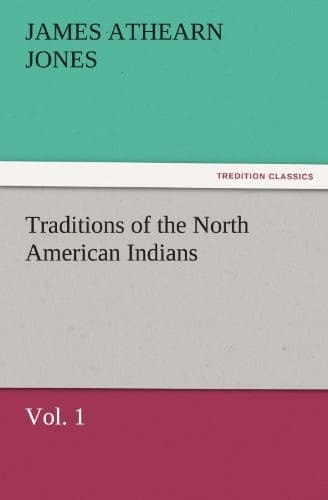
Traditions of the North American Indians, Vol. 1Jones, James Athearn
History
Traditions of the North American Indians, Vol. 1
Jones, James Athearn
Indians of North America -- Folklore
Three suns had passed, and the knowledge of the cause still remained
hidden from them. On the morning of the fourth day, when the chief went
out of his lodge, he found his beloved daughter weeping by the door of
the cabin. Oh! how changed was the beautiful Mekaia--she was no longer a
Star-flower. The brightness of her eye had departed, as the beauty of
the green fields and leafy forests is driven hence by the chills of
winter, her cheek was sunken and hollow, her long black locks lay
uncombed upon her shoulders, and the joy and cheerfulness which once
warmed her heart, and made her foot lighter than the antelope's, were no
more. She, whose feet were fleeter than the deer's, now walked feebly,
and rested oft; she, whose tongue outchirped the merriest birds of the
grove, and warbled sweeter music than the song-sparrow, now spoke in
strains as gloomy and sad as the bittern that cries in the swamps when
night is coming on, or the solitary bird of wisdom perched among the
leaves of the oak. The father sat down by her, and asked her whence she
came.
"From the valley upon this side of the mountains," she answered.
"Where is thy husband?" demanded Wasabajinga.
"Dead," answered the Starflower, and wept afresh.
"Wah!" exclaimed the warrior, and hid his face with his hands. When he
had sat thus awhile, he inquired the manner of his death. She told him,
that, before they reached the mountains of the Wahconda, they saw a pale
man coming towards them, mounted on a low, black horse. When he came up
them, he asked her husband if he would buy blankets, and beads, and the
fire-eater. That the Wahconda's son answered, "No;" and told him it was
very--very bad in him to carry the fire-eater, to destroy the poor
misguided Indians. The man upon the black horse answered, "That he was a
better man than the Wahconda's son, for he was no heathen, but lived
where men worshipped a greater Wahconda than his father in a beautiful
house built with hands, and not beneath the shade of the cypress and the
oak." Upon this, her husband did but smile, when the pale man elevated
the spear he carried in his hand, and, with the bolts which issued from
it, struck him to the earth, from which he never rose again. Then there
came a cry of mourning from the cabin of the Little Black Bear. The
women rushed out, and tore their hair, and cut their flesh with sharp
stones, through grief for the death of the husband of their beloved
Starflower. And they sung a melancholy lament, for the youth who had
perished in the morning of life, while the down was yet upon his cheek,
and his heart had never felt the shaft of sorrow. They sung how happy
the lovers were, ere the malice and cruelty of white men destroyed their
joys; ere their sacrilegious hands had laid one low in the dust, and
left the other to pine under the bereavement, till death would be a
blessing. They painted the anger and grief of the great Wahconda when he
found the darling of his house numbered with the slain. They sung that,
Public-domain text, read in full here on John Shaqi.
Reviews
Reviews
No reviews yet
Be the first to share your thoughts on this work.
Elsewhere in the archive
Join the Discussion
Join the discussion
Sign in to leave a comment or review.
Sign InorCreate an account