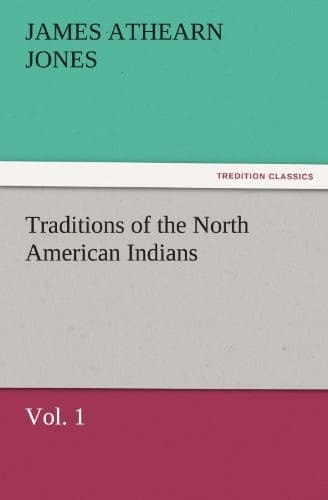
Traditions of the North American Indians, Vol. 1Jones, James Athearn
History
Traditions of the North American Indians, Vol. 1
Jones, James Athearn
Indians of North America -- Folklore
These were the concluding words of the Spirit-wife. When they looked up
she was gone from their sight, no one knew whither. Presently there was
a slight fall of snow, which soon, however, again gave place to the
beams of the warm and refreshing sun. They never saw her again. They
never saw her again, but they forgot neither her nor her wishes. The
children she left were adopted by the nation, and became in time so many
of them fathers and mothers, that, at this day, half the tribe are
descended from them.
My brother asks, if the good Spirit-wife kept her promise to the Tetons.
She did, as he will see, if he will but look at the northern skies in
the time of summer and autumn. He will then see flashing over the face
of the broad heavens the flames which the good people kindle to thaw the
frosty air, and thus remove the impediments which exist to the merry
dance of the souls of those Tetons, who have repaired to the Happy
Abode. He will hear very plain the laugh[A] of the sprightly dancers;
and frequently, when the air is very clear, he will see their nimble
forms dancing up and down the moonbeams. Who would not wish that his
spirit might be permitted to go to THE TETON'S PARADISE?
[Footnote A: The _aurora borealis_, or "northern light," as my readers
know, is usually attended by a whizzing sound, somewhat resembling
laughter.]
Brother, this is no lie.
NOTES.
(1) _String of Wampum_.--p. 293.
A party of Indians, intending to go to war, first observe a rigorous and
protracted fast. When the fast is ended, he who is to command it
assembles his friends, and, holding in his hand a string of wampum,
makes a speech, in which the causes of war, and the injuries and insults
which justify it, are fully and artfully set forth. When he has
finished, he lays the collar on the ground, and he who takes it up, by
so doing, declares himself embarked in the same expedition.
(2) _Eat up the Nation_.--p. 294.
This is a frequent figure of the Indian orator, when endeavouring to
inflame the passions of his hearers. It signifies that a war is to be
waged against the nation respecting whom the "talk" is held, in the most
outrageous and destructive manner. When they wish to engage in their
quarrel an ally who is not present, they send a belt of wampum, with an
invitation to him to drink the "blood" or "the broth of the flesh of
their enemies." It is not to be inferred from this, that the North
American Indians are _Anthropophagi_. It is undoubtedly an allegorical
manner of speaking, with frequent examples of which the Scriptures
furnish us, _e.g._ Psalms xxvii. 2.
(3) _The stormy Lake of Michabou._--p. 294.
Public-domain text, read in full here on John Shaqi.
Reviews
Reviews
No reviews yet
Be the first to share your thoughts on this work.
Elsewhere in the archive
Join the Discussion
Join the discussion
Sign in to leave a comment or review.
Sign InorCreate an account