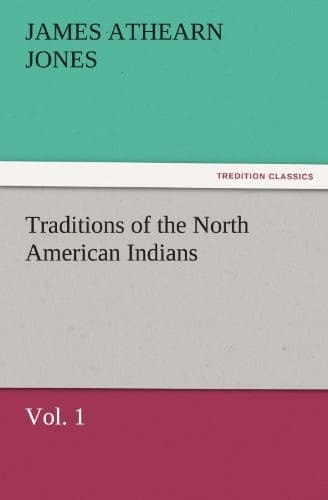
Traditions of the North American Indians, Vol. 1Jones, James Athearn
History
Traditions of the North American Indians, Vol. 1
Jones, James Athearn
Indians of North America -- Folklore
The Indians believe that Michabou, the God of the Waters, formed Lake
Superior to serve as a nursery for beavers. The rocks at the _Sault de
Saint Marie_, or Falls of St. Mary, according to the tradition of the
Indians, are the remains of a causeway made by the God in order to dam
up the waters of the rivers, which supply this great lake. At the time
he did this, he lived, they add, at Michillimackinac, _i.e._ a great
place for turtles, pronounced Mak-i-naw. He it was who taught the
ancestors of the Indians to fish, and invented nets, of which he took
the idea from the spider's web. Very many of the northern tribes
recognise this same divinity, but the Hurons alone assign Lake Superior
as the place of his residence.
(4) _House of Death._--p. 302.
The funeral customs of the Indians are very various, and all are
sufficiently curious to merit a place in this note. I have only space
for a few. The first extract relates rather to the place of deposit for
the dead, than to the dead themselves. It describes the common cemetery
of the tribes living west of the Rocky Mountains.
"Among the Pishquitpaws, who live beyond the Rocky Mountains, the place
in which the dead are deposited is a building about sixty feet long, and
twelve feet wide, and is formed by placing in the ground poles or forks
six feet high, across which a long pole is extended the whole length of
the structure. Against this ridge-pole are placed broad boards and
pieces of canoes in a slanting direction, so as to form a shed. It
stands east and west, and neither of the extremities are closed. On
entering the western end we observed a number of bodies, wrapped
carefully in leather robes, and arranged in rows on boards, which were
then covered with mats. This was the part destined for those who had
recently died: a little further on, bones half decayed were scattered
about, and in the centre of the building was a large pile of them heaped
promiscuously on each other. At the western extremity was a mat on which
twenty-one sculls were placed in a circular form, the mode of interment
being first to wrap the body in robes, and as it decays the bones are
thrown into the heap, and the sculls placed together. From the different
boards and pieces of canoes which form the vault were suspended on the
inside fishing-nets, baskets, wooden bowls, robes, skins, trenchers, and
trinkets of various kinds, obviously intended as offerings of affection
to deceased relatives. On the outside of the vault were the skeletons of
several horses, and great quantities of bones were in the neighbourhood,
which induced us to believe that these animals were most probably
sacrificed at the funeral rites of their masters."--_Lewis and Clarke_,
ii, 24.
Public-domain text, read in full here on John Shaqi.
Reviews
Reviews
No reviews yet
Be the first to share your thoughts on this work.
Elsewhere in the archive
Join the Discussion
Join the discussion
Sign in to leave a comment or review.
Sign InorCreate an account