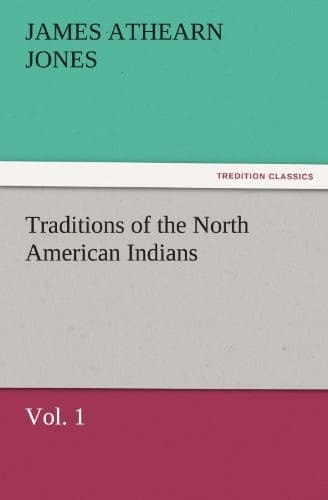
Traditions of the North American Indians, Vol. 1 — John Shaqi
Traditions of the North American Indians, Vol. 1Jones, James Athearn
History
Traditions of the North American Indians, Vol. 1
Jones, James Athearn
Indians of North America -- Folklore
Two moons had passed--then a third--then came the night enlivened by
many stars--but the warriors returned not. As the land of the Walkullas
lay but a woman's journey of six suns from the villages of our nation,
our people began to fear that our young men had been overcome in battle,
and were all slain. The head chief and the counsellors, and all the
warriors who had remained behind, came together in the great wigwam[A],
and called the priests, to tell them where their sons were. Chenos, who
was the wisest of them all, as well he might be (for he was older than
the oak-tree whose top dies by the hand of Time), answered that they
were killed by their enemies, the Walkullas, assisted by men of a
strange speech and colour, who lived beyond the Great Salt Lake, fought
with thunder and lightning, and came to our enemies on the back of a
great bird with many white wings. When he had thus made known to our
people the fate of the warriors, there was a dreadful shout of horror
throughout the village. The women wept aloud, and the men sprung up and
seized their bows and arrows, to go to war upon the Walkullas, and the
strange warriors who had helped to slay their sons; but Chenos bade them
sit down. "There is one yet living," said he. "He will soon be here. The
sound is in my ear of his footsteps, as he crosses the hollow hills. He
has killed many of his enemies; he has glutted his vengeance fully; he
has drunk blood in plenteous draughts. Long he fought with the men of
his own race, and many fell before him; but he fled from the men who
came to the battle armed with the red lightning, and hurling unseen
death. Even now I see him coming. The shallow streams he has forded, the
deep rivers he has swum. He is tired and hungry; and his quiver has no
arrows, but he brings a prisoner in his arms. Lay the deer's flesh on
the coals, and bring hither the pounded corn. Taunt him not, for he is
valiant, and has fought like a hungry lion."
[Footnote A: Great wigwam, an Indian expression, signifying the
council-house.]
As the wise Chenos spoke these words to the grey-headed counsellors and
warriors, the Mad Buffalo walked, calm and cool, into the midst of them.
There he stood, tall and straight as a young pine; but he spoke no word,
looking with a full eye on the head chief and the counsellors. There was
blood upon his body, dried on by the sun, and the arm next his heart was
bound up with the skin of the deer. His eye looked hollow, and his body
gaunt, as though he had fasted long. His quiver had no arrows; but he
had seven scalps hanging to the pole on his back, six of which had long
black hair, but that which grew upon the seventh was yellow as the
fallen leaf, and curled like the tendrils of the wild ivy.
"Where are our sons?" enquired the head chief of the warrior.
"Ask the wolf and the panther," he answered.
Public-domain text, read in full here on John Shaqi.
Reviews
Reviews
No reviews yet
Be the first to share your thoughts on this work.
Join the Discussion
Join the discussion
Sign in to leave a comment or review.
Sign InorCreate an account