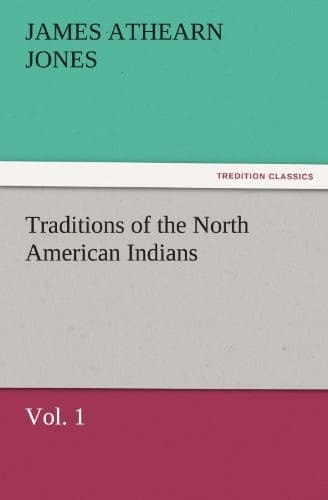
Traditions of the North American Indians, Vol. 1 — John Shaqi
Traditions of the North American Indians, Vol. 1Jones, James Athearn
History
Traditions of the North American Indians, Vol. 1
Jones, James Athearn
Indians of North America -- Folklore
"The Legend of Moshup" (Vol. 2, p. 261) is one of those related to me by
my old Indian nurse. It is, I think, corroborated in a communication
made to the Massachusetts Historical Society, and published in their
Transactions; but, not having been able to find a copy in England, I
must beg the reader to rest satisfied with my assertion that,
independently of my nurse's version, a communication made to the
before-mentioned society stamps the tradition as genuine.
"The Phantom Woman" (Vol. 2, p. 273) I heard from a Winnebago Indian at
Washington, and I have somewhere met with it in print; I dare not
assert, but I think, that it is referred to by a Mr. McKenney, in a
book of travels published some years ago in America.
"The Two Ghosts" (Vol. 2, p. 285) is from Mr. Schoolcraft's work.
"The Vision of the Abnakis Chief." (Vol., 2, p. 303). This was a legend
of my old nurse, and evidently refers, like several others, to the
coming of the Whites.
"The Lake of the White Canoe" (Vol. 3, p. 1) is a common tradition in
the region where the incidents are supposed to have happened. I should
remark, however, that the tale is not always told of Indians, but by
some is supposed to have happened to a pair of White lovers. The better
account, however, makes them Indians. What adds to the interest of this
tradition is, that Mr. Thomas Moore has made it the subject of a
beautiful ballad entitled "The Lake of the Dismal Swamp." His having
taken up the story should, I am aware, have prevented me from attempting
to tell it, since it is impossible that any thing from my pen should
equal his beautiful poetical version.
"A Legend of the Bomelmeeks" (Vol. 3, p. 33) I heard from an Indian of
the Seneca tribe, whom I saw at Albany, in the State of New York. I am
not aware of its having been in print before.
"The King of the Elks" (Vol. 3, p. 47) I heard from the same old Indian
story-teller. I am not aware of its resting on any other foundation.
"The Daughters of the Sun" (Vol. 3, p. 77) is referred to by Leyden in
his "Scenes of Infancy," and by Bertram in his "Travels through the
Carolinas." (London, 1794. p. 25).
"The Island of Eagles"--(Vol. 3, p. 117). I heard this tradition from an
Indian whom I saw at Wheeling, in the State of Ohio, in 1823. I had
before read Carver's description of this island, and upon meeting with
this Indian, who had been there, and questioning him, he related this
tradition.
"Legend of Aton-Larre." This I heard from an old Indian at Fayetteville,
North Carolina, while I was travelling through that state in 1819.
"The Fire Spirit." (Vol. 3, p. 167). This was derived from the same
source as the last. I have read or heard a rather different version, but
I cannot recollect where.
Public-domain text, read in full here on John Shaqi.
Reviews
Reviews
No reviews yet
Be the first to share your thoughts on this work.
Join the Discussion
Join the discussion
Sign in to leave a comment or review.
Sign InorCreate an account