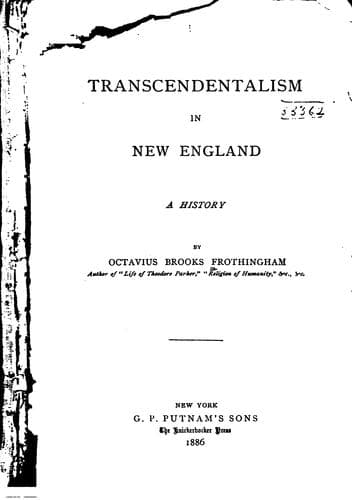
Transcendentalism in New England: A HistoryFrothingham, Octavius Brooks
Philosophy
Transcendentalism in New England: A History
Frothingham, Octavius Brooks
Transcendentalism (New England)
"It was the doctrine of the Samian Sage, that whatsoever food obstructs
divination, is prejudicial to purity and chastity of mind and body, to
temperance, health, sweetness of disposition, suavity of manners, grace
of form and dignity of carriage, should be shunned. Especially should
those who would apprehend the deepest wisdom, and preserve through life
the relish for elegant studies and pursuits, abstain from flesh,
cherishing the justice which animals claim at men's hands, nor
slaughtering them for food or profit." "A purer civilization than ours
can yet claim to be, is to inspire the genius of mankind with the skill
to deal dutifully with soils and souls, exalt agriculture and manculture
into a religion of art; the freer interchange of commodities which the
current world-wide intercourse promotes, spreads a more various,
wholesome, classic table, whereby the race shall be refined of traits
reminding too plainly of barbarism and the beast." Said Timotheus of
Plato, "they who dine with the philosopher have nothing to complain of
the next morning." That the doctrine has its warm, glowing side,
appears in a characteristic poem in the little volume called "Tablets."
The anchorite's plea was not always as good as his practice. Arguing the
point once with a sagacious man of the world, he urged as a reason for
abstinence from animal food that one thereby distanced the animal. For
the eating of beef encouraged the bovine quality, and the pork diet
repeats the trick of Circe, and changes men into swine. But, rejoined
the friend, if abstinence from animal food leaves the animal out, does
not partaking of vegetable food put the vegetable in? I presume the
potato diet will change man into a potato. And what if the potatoes be
small! The philosopher's reply is not recorded. But in his case the
beast did disappear, and the leek has never become prominent. In his
case health, strength, agility, sprightliness, cheerfulness, have been
wholly compatible with disuse of animal food. Few men have preserved the
best uses of body and mind so long unimpaired. Few have lost so few
days; have misused so few; are able to give a good account of so many.
The vegetarian of seventy-six shames many a cannibal of forty.
Public-domain text, read in full here on John Shaqi.
Reviews
Reviews
No reviews yet
Be the first to share your thoughts on this work.
Elsewhere in the archive
Join the Discussion
Join the discussion
Sign in to leave a comment or review.
Sign InorCreate an account