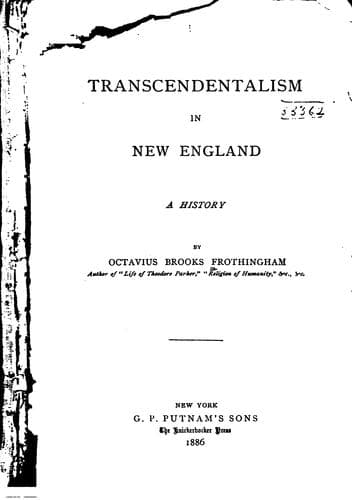
Transcendentalism in New England: A HistoryFrothingham, Octavius Brooks
Philosophy
Transcendentalism in New England: A History
Frothingham, Octavius Brooks
Transcendentalism (New England)
The Transcendentalist was by nature a reformer. He could not be
satisfied with men as they were. His doctrine of the capacities of men,
even in its most moderate statement, kindled to enthusiasm his hope of
change. However his disgust may have kept him aloof for a time, his
sympathy soon brought him back, and his faith sent him to the front of
the battle. In beginning his lecture on "Man The Reformer," Mr. Emerson
does not dissemble his hope that each person whom he addresses has
"felt his own call to cast aside all evil customs, timidities and
limitations, and to be in his place a free and helpful man, a reformer,
a benefactor, not content to slip through the world like a footman or a
spy, escaping by his nimbleness and apologies as many knocks as he can,
but a brave and upright man, who must find or cut a straight path to
everything excellent in the earth, and not only go honorably himself,
but make it easier for all who follow him, to go in honor and with
benefit." "The power," he declares, "which is at once spring and
regulator in all efforts of reform, is the conviction that there is an
infinite worthiness in man, which will appear at the call of worth, and
that all particular reforms are the removing of some impediment. Is it
not the highest duty that man should be honored in us?" "In the history
of the world" the same great teacher remarks, "the doctrine of Reform
had never such scope as at the present hour. Lutherans, Herrnhütters,
Jesuits, Monks, Quakers, Knox, Wesley, Swedenborg, Bentham, in their
accusations of society, all respected something,--church or state,
literature or history, domestic usages, the market town, the dinner
table, coined money. But now all these and all things else hear the
trumpet and must rush to judgment,--Christianity, the laws, commerce,
schools, the farm, the laboratory: and not a kingdom, town, statute,
rite, calling, man, or woman but is threatened by the new spirit." "Let
me feel that I am to be a lover. I am to see to it that the world is the
better for me, and to find my reward in the act. Love would put a new
face on this weary old world in which we dwell as pagans and enemies too
long, and it would warm the heart to see how fast the vain diplomacy of
statesmen, the impotence of armies, and navies, and lines of defence,
would be superseded by this unarmed child."
Public-domain text, read in full here on John Shaqi.
Reviews
Reviews
No reviews yet
Be the first to share your thoughts on this work.
Elsewhere in the archive
Join the Discussion
Join the discussion
Sign in to leave a comment or review.
Sign InorCreate an account