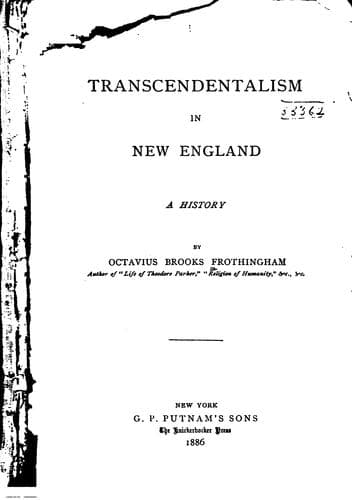
Transcendentalism in New England: A HistoryFrothingham, Octavius Brooks
Philosophy
Transcendentalism in New England: A History
Frothingham, Octavius Brooks
Transcendentalism (New England)
In no respect does the Transcendentalist's idea of social reform stand
out more conspicuously than in this. With an incessant and passionate
aspiration after a pure social state,--deeply convinced of the mistakes,
profoundly sensible of the miseries of the actual condition, he would
not be committed to experiments that did not assume his first
principle--the supreme dignity of the individual man. The systems of
French socialism he distrusted from the first; for they proceeded on the
ground that man is not a self determined being, but a creature of
circumstance. Mr. Albert Brisbane's attempt to domesticate Fourierism
among us was cordially considered, but not cordially welcomed. He seemed
to have no spiritual depth of foundation; his proposition to imprison
man in a Phalanx, was rejected; his omission of moral freedom in the
scheme was resented; no sincerity, no keenness of criticism, no exposure
of existing evils or indignation of protest against them, disarmed the
jealousy of endeavors to reconstruct society, as if human beings were
piles of brick or lumps of mortar.
In 1841 a community was planned in Massachusetts, by Liberal Christians
of the Universalist sect. Though never put in operation it did not
escape the criticism of the "Dial." The good points were recognized and
commended; the moral features were praised as showing a deep insight
into the Christian idea, and the articles of confederation were
pronounced admirable in judgment and form, with a single exception,
which however was fatal. Admittance of members was conditioned on
pledges of non-resistance, abolition, temperance, abstinence from
voting, and such like. Though these conditions were easy enough in
themselves, and were expressed in the most conciliatory spirit, they
were justly regarded as giving to the community the character of a
church or party, much less than world embracing. "A true community," it
was declared, "can be founded on nothing short of faith in the universal
man, as he comes out of the hands of the Creator, with no law over his
liberty but the eternal ideas that lie at the foundation of his being."
"The final cause of human society is the unfolding of the individual
man, into every form of perfection, without let or hindrance, according
to the inward nature of each."
When the Brook Farm experiment was under way at West Roxbury, its
initiators were warned against three dangers: the first, _Organization_,
which begins by being an instrument and ends by being a master; the
second, _Endowment_, which promises to be a swift helper, and is, ere
long, a stifling encumbrance; the third, the spirit of _Coterie_, which
would in no long time, shrink their rock of ages to a platform, diminish
their brotherhood to a clique, and reduce their aims to experiences.
Public-domain text, read in full here on John Shaqi.
Reviews
Reviews
No reviews yet
Be the first to share your thoughts on this work.
Elsewhere in the archive
Join the Discussion
Join the discussion
Sign in to leave a comment or review.
Sign InorCreate an account