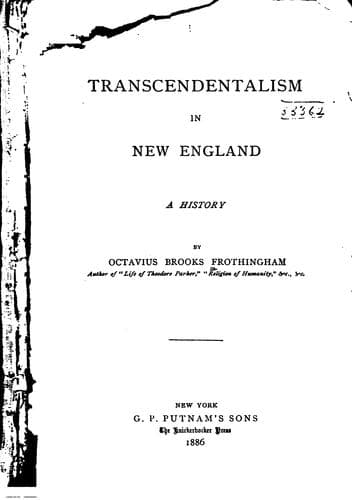
Transcendentalism in New England: A HistoryFrothingham, Octavius Brooks
Philosophy
Transcendentalism in New England: A History
Frothingham, Octavius Brooks
Transcendentalism (New England)
The method of reform followed from the principle. It was the method of
individual awakening and regeneration, and was to be conducted "through
the simplest ministries of family, neighborhood, fraternity, quite wide
of associations and institutions." "The true reformer," it was
proclaimed, "initiates his labor in the precincts of private life, and
makes it, not a set of measures, not an utterance, not a pledge merely,
but a life; and not an impulse of a day, but commensurate with human
existence: a tendency towards perfection of being." The
Transcendentalist might easily become an enthusiast from excess of
faith; but a fanatic, with a tinge of melancholy in his disposition, a
drop of malignity in his blood, he could not be. He was less a reformer
of human circumstance than a regenerator of the human spirit, and he was
never a destroyer except as destruction accompanied the process of
regeneration.
This fine positive purpose appeared in all he undertook. With movements
that did not start from this primary assumption of individual dignity,
and come back to that as their goal, he had nothing to do. Was he an
anti-slavery man--and he was certain to be one at heart--the
Transcendentalists were glowing friends of that reform,--he was so
because his philosophy compelled him to see in the slave the same
humanity that appeared in the master; in the African the same
possibilities that were confessed in the Frank, the Anglo-Saxon, and the
Celt. Did he take up the cause of education, it was as a believer in the
latent capacity of every child, boy or girl; as an earnest wisher that
such capacity might be stimulated by the best methods, and directed to
the best ends. What he effected, or tried to effect in this way will be
understood by the reader of the record of Mr. Alcott's school; that bold
and original attempt at educating, leading or drawing out young minds,
which showed such remarkable promise, and would have achieved such
remarkable results had more faithful trial of its method been possible.
Was he a reformer of society, it was as a vitalizer, not as a machinist.
Public-domain text, read in full here on John Shaqi.
Reviews
Reviews
No reviews yet
Be the first to share your thoughts on this work.
Elsewhere in the archive
Join the Discussion
Join the discussion
Sign in to leave a comment or review.
Sign InorCreate an account