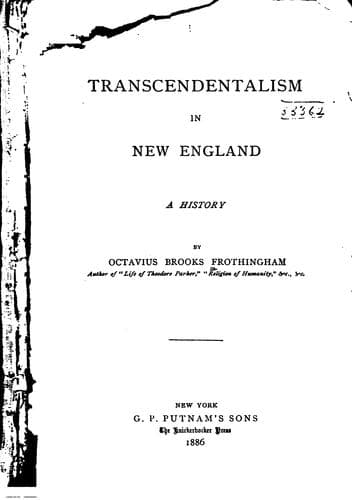
Transcendentalism in New England: A HistoryFrothingham, Octavius Brooks
Philosophy
Transcendentalism in New England: A History
Frothingham, Octavius Brooks
Transcendentalism (New England)
It was felt at this time, 1842, that, in order to live a religious and
moral life in sincerity, it was necessary to leave the world of
institutions, and to reconstruct the social order from new beginnings. A
farm was bought in close vicinity to Boston; agriculture was made the
basis of the life, as bringing man into direct and simple relations with
nature, and restoring labor to honest conditions. To a certain extent,
it will be seen, the principle of community in property was recognized,
community of interest and coöperation requiring it; but to satisfy the
claims and insure the rights of the individual, members were not
required to impoverish themselves, or to resign the fruit of their
earnings.
Provisions were either raised on the farm or purchased at wholesale.
Meals were eaten in "commons." It was the rule that all should
labor--choosing their occupations, and the number of hours, and
receiving wages according to the hours. No labor was hired that could be
supplied within the community; and all labor was rewarded alike, on the
principle that physical labor is more irksome than mental, more
absorbing and exacting, less improving and delightful. Moreover, to
recognize practically the nobility of labor in and of itself, none were
appointed to special kinds of work. All took their turn at the several
branches of employment. None were drudges or menials. The intellectual
gave a portion of their time to tasks such as servants and handmaidens
usually discharge. The unintellectual were allowed a portion of their
time for mental cultivation. The benefits of social intercourse were
thrown open to all. The aim was to secure as many hours as practicable
from the necessary toil of providing for the wants of the body, that
there might be more leisure to provide for the deeper wants of the soul.
The acquisition of wealth was no object. No more thought was given to
this than the exigencies of existence demanded. To live, expand, enjoy
as rational beings, was the never-forgotten aim.
The community trafficked by way of exchange and barter with the outside
world; sold its surplus produce; sold its culture to as many as came or
sent children to be taught. It was hoped that from the accumulated
results of all this labor, the appliances for intellectual and spiritual
health might be obtained; that books might be bought, works of art,
scientific collections and apparatus, means of decoration and
refinement, all of which should be open on the same terms to every
member of the association. The principle of coöperation was substituted
for the principle of competition; self development for selfishness. The
faith was avowed in every arrangement that the soul of humanity was in
each man and woman.
Public-domain text, read in full here on John Shaqi.
Reviews
Reviews
No reviews yet
Be the first to share your thoughts on this work.
Elsewhere in the archive
Join the Discussion
Join the discussion
Sign in to leave a comment or review.
Sign InorCreate an account