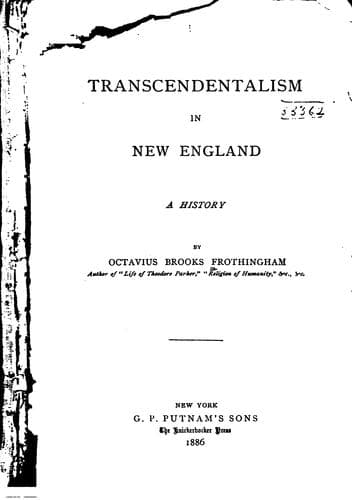
Transcendentalism in New England: A HistoryFrothingham, Octavius Brooks
Philosophy
Transcendentalism in New England: A History
Frothingham, Octavius Brooks
Transcendentalism (New England)
SEC. 3. The chairman of the General Direction shall be the
President of the Association, and together with the Direction of
Finance, shall constitute a board of Trustees, by whom the property
of the Association shall be held and managed.
SEC. 4. The General Direction shall oversee and manage the affairs
of the Association, so that every department shall be carried on in
an orderly and efficient manner.
SEC. 5. The departments of Education and Finance shall be under the
control each of its own Direction, which shall select, and in
concurrence with the General Direction, shall appoint such
teachers, officers, and agents, as shall be necessary to the
complete and systematic organization of the department. No
Directors or other officers shall be deemed to possess any rank
superior to the other members of the Association, nor shall they
receive any extra remuneration for their official services.
SEC. 6. The department of industry shall be arranged in groups and
series, as far as practicable, and shall consist of three primary
series; to wit, Agricultural, Mechanical, and Domestic Industry.
The chief of each series shall be elected every two months by the
members thereof, subject to the approval of the general Direction.
The chief of each group shall be chosen weekly by its members.
ARTICLE VI.
MISCELLANEOUS.
SEC. 1. The Association may from time to time adopt such by-laws,
not inconsistent with the spirit and purpose of these articles, as
shall be found expedient or necessary.
SEC. 2. In order to secure to the Association the benefits of the
highest discoveries in social science, and to preserve its fidelity
to the principles of progress and reform, on which it is founded,
any amendment may be proposed to this Constitution at a meeting
called for the purpose; and if approved by two-thirds of the
members at a subsequent meeting, at least one month after the date
of the first, shall be adopted.
From this it appears that the association was simply an attempt to
return to first principles, to plant the seeds of a new social order,
founded on respect for the dignity, and sympathy with the aspirations of
man. It was open to all sects; it admitted, welcomed, nay, demanded all
kinds and degrees of intellectual culture. The most profound regard for
individual opinion, feeling and inclination, was professed and
exhibited. Confidence that surrender to the spontaneous principle, with
no more restriction than might be necessary to secure its development,
was wisest, lay at the bottom of the scheme.
Public-domain text, read in full here on John Shaqi.
Reviews
Reviews
No reviews yet
Be the first to share your thoughts on this work.
Elsewhere in the archive
Join the Discussion
Join the discussion
Sign in to leave a comment or review.
Sign InorCreate an account