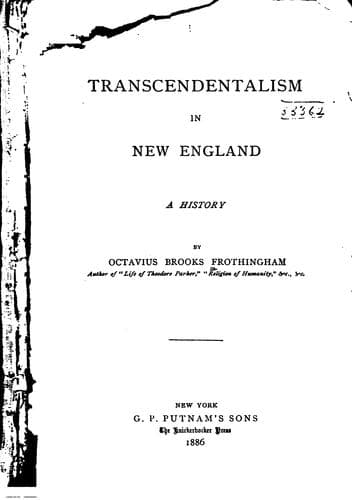
Transcendentalism in New England: A HistoryFrothingham, Octavius Brooks
Philosophy
Transcendentalism in New England: A History
Frothingham, Octavius Brooks
Transcendentalism (New England)
The details above given convey no adequate idea of the Brook Farm
fraternity. In one sense it was much less than they imply; in another
sense it was much more. It was less, because its plan was not materially
successful; the intention was defeated by circumstances; the hope turned
out to be a dream. Yet, from another aspect, the experiment fully
justified itself. Its moral tone was high; its moral influence sweet and
sunny. Had Brook Farm been a community in the accepted sense, had it
insisted on absolute community of goods, the resignation of opinions, of
personal aims interests or sympathies; had the principle of
renunciation, sacrifice of the individual to the common weal, been
accepted and maintained, its existence might have been continued and its
pecuniary basis made sure. But asceticism was no feature of the original
scheme. On the contrary, the projectors of it were believers in the
capacities of the soul, in the safety, wisdom and imperative necessity
of developing those capacities, and in the benign effect of liberty. Had
the spirit of rivalry and antagonism been called in, the sectarian or
party spirit, however generously interpreted, the result would probably
have been different. But the law of sympathy being accepted as the law
of life, exclusion was out of the question; inquisition into beliefs was
inadmissible; motives even could not be closely scanned; so while some
were enthusiastic friends of the principle of association, and some
were ardent devotees to liberty, others thought chiefly of their private
education and development; and others still were attracted by a desire
of improving their social condition, or attaining comfort on easy terms.
The idea, however noble, true, and lovely, was unable to grapple with
elements so discordant. Yet the fact that these discordant elements did
not, even in the brief period of the fraternity's existence, utterly
rend and abolish the idea; that to the last, no principle was
compromised, no rule broken, no aspiration bedraggled, is a confession
of the purity and vitality of the creative thought. That a mere
aggregation of persons, without written compact, formal understanding,
or unity of purpose, men, women and children, should have lived
together, four or five years, without scandal or reproach from
dissension or evil whisper, should have separated without rancor or
bitterness, and should have left none but the pleasantest savor behind
them--is a tribute to the Transcendental Faith.
Public-domain text, read in full here on John Shaqi.
Reviews
Reviews
No reviews yet
Be the first to share your thoughts on this work.
Elsewhere in the archive
Join the Discussion
Join the discussion
Sign in to leave a comment or review.
Sign InorCreate an account