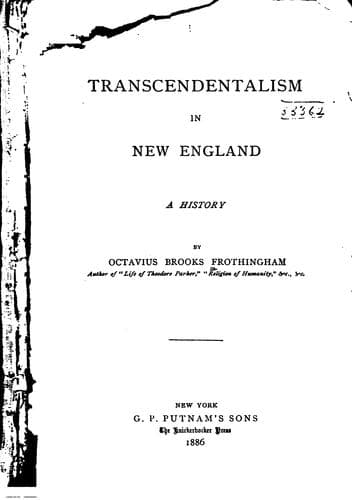
Transcendentalism in New England: A HistoryFrothingham, Octavius Brooks
Philosophy
Transcendentalism in New England: A History
Frothingham, Octavius Brooks
Transcendentalism (New England)
In 1844, the Directors of the Association, George Ripley, Minot Pratt,
and Charles Anderson Dana, published a statement, declaring: that every
step had strengthened the faith with which they set out; that their
belief in a divine order of human society had in their minds become an
absolute certainty; that, in their judgment, considering the state of
humanity and of social science, the world was much nearer the attainment
of such a condition than was generally supposed. They here said
emphatically that Fourier's doctrine of universal unity commanded their
unqualified assent, and that their whole observation had satisfied them
of the practical arrangements which he deduced therefrom, of the
correspondence of the law of groups and series with the law of human
nature. At this time the farm contained two hundred and eight acres, and
could be enlarged to any extent necessary. The Association held property
worth nearly or quite thirty thousand dollars, of which about twenty-two
thousand was invested, either in the stock of the company or in
permanent loans to it at six per cent., which could remain as long as the
Association might wish. The organization was pronounced to be in a
satisfactory working condition; the Department of Education, on which
much thought had been bestowed, was flourishing. With a view to an
ultimate expansion into a perfect Phalanx, it was proposed to organize
the three primary departments of labor, namely, Agriculture, Domestic
Industry, and the Mechanical Arts. Public meetings had awakened an
interest in the community. Appeals for money had been generously
answered. The numbers had been increased by the accession of many
skilful and enthusiastic laborers in various departments. About ten
thousand dollars had been added by subscription to the capital. A
work-shop sixty feet by twenty-eight had been erected; a Phalanstery, or
unitary dwelling on a large scale, was in process of erection, to meet
the early needs of the preparatory period, until success should
authorize the building of a Phalanstery "with the magnificence and
permanence proper to such a structure." The prospect was, or looked,
encouraging. The experiment had been tested by the hard discipline of
more than two years; the severest difficulties had apparently been
conquered; the arrangements had attained systematic form, as far as the
limited numbers permitted; the idea was respectfully entertained;
socialism was spreading; it embraced persons of every station in life;
and in its extent, and influence on questions of importance, it seemed,
to enthusiastic believers, to be fast assuming in the United States a
national character. This was in October 1844. At this time the Brook
Farm Associationists connected themselves with the New York Socialists
who accepted the teachings of Fourier; and the efforts described were
put forth in aid of the new and more systematic plans that had been
adopted. But this coalition, which promised so much, proved disastrous
in its result.
Public-domain text, read in full here on John Shaqi.
Reviews
Reviews
No reviews yet
Be the first to share your thoughts on this work.
Elsewhere in the archive
Join the Discussion
Join the discussion
Sign in to leave a comment or review.
Sign InorCreate an account