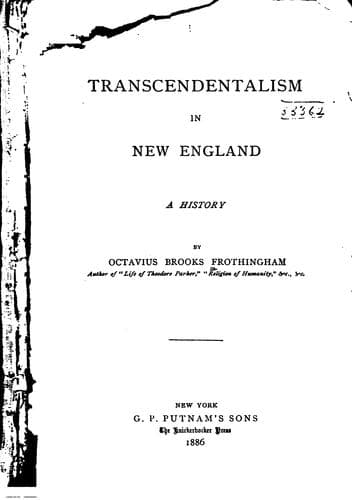
Transcendentalism in New England: A HistoryFrothingham, Octavius Brooks
Philosophy
Transcendentalism in New England: A History
Frothingham, Octavius Brooks
Transcendentalism (New England)
The Association was unable to sustain industrial
competition with established trades. The expenses were more than the
receipts. In the spring of 1847 the Phalanstery was burned down; the
summer was occupied in closing up the affairs; and in the autumn the
Association was broken up. The members betook themselves to the world
again, and engaged in the ordinary pursuits of life. The farm was bought
by the town of West Roxbury, and afterwards passed into private hands.
During the civil war the government used it for military purposes. The
main building has since been occupied as a hospital. The leaders of the
Association removed to New York, and for about a year, till February
1849, continued their labors of propagandism by means of the
"Harbinger," till that expired: then their dream faded away.
The full history of that movement can be written only by one who
belonged to it, and shared its secret: and it would doubtless have been
written before this, had the materials for a history been more solid.
Aspirations have no history. It is pleasant to hear the survivors of the
pastoral experiment talk over their experiences, merrily recall the
passages in work or play, revive the impressions of country rambles,
conversations, discussions, social festivities, recount the comical
mishaps, summon the shadows of friends dead, but unforgotten, and
describe the hours spent in study or recreation, unspoiled by
carefulness. But it is in private alone that these confidences are
imparted. To the public very little has been, or will be, or can be
told.
Mr. Hawthorne was one of the first to take up the scheme. He was there a
little while at the beginning in 1841, and his note-books contain
passages that are of interest. But Hawthorne's temperament was not
congenial with such an atmosphere, nor was his faith clear or steadfast
enough to rest contented on its idea. His, however, were observing eyes;
and his notes, being soliloquies, confessions made to himself, convey
his honest impressions:
BROOK FARM, April 13th, 1841. "I have not taken yet my first lesson
in agriculture, except that I went to see our cows foddered,
yesterday afternoon. We have eight of our own; and the number is
now increased by a Transcendental heifer belonging to Miss Margaret
Fuller. She is very fractious, I believe, and apt to kick over the
milk pail.... I intend to convert myself into a milk-maid this
evening, but I pray Heaven that Mr. Ripley may be moved to assign
me the kindliest cow in the herd, otherwise I shall perform my
duties with fear and trembling. I like my brethren in affliction
very well, and could you see us sitting round our table at meal
times, before the great kitchen fire, you would call it a cheerful
sight."
Public-domain text, read in full here on John Shaqi.
Reviews
Reviews
No reviews yet
Be the first to share your thoughts on this work.
Elsewhere in the archive
Join the Discussion
Join the discussion
Sign in to leave a comment or review.
Sign InorCreate an account