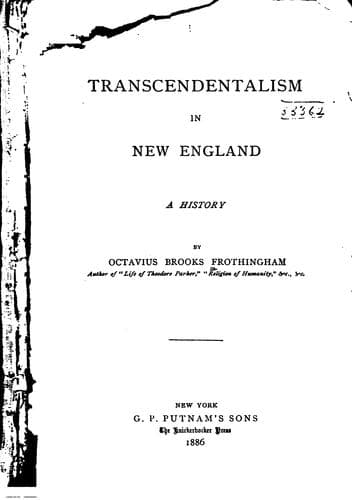
Transcendentalism in New England: A HistoryFrothingham, Octavius Brooks
Philosophy
Transcendentalism in New England: A History
Frothingham, Octavius Brooks
Transcendentalism (New England)
Mr. Hawthorne was elected to high offices, to those of Trustee of the
Brook Farm estate, and Chairman of the Committee of Finance; but he told
Mr. Ripley that he could not spend another winter there. If we could
inspect all the note-books of the community, supposing all to be as
frank as Hawthorne, our picture of Brook Farm life would be fascinating.
But his was, perhaps, the only note-book kept in the busy brotherhood,
and his rather sombre view must be accepted as the impression of one
peculiar mind. In the "Blithedale Romance," Hawthorne disclaimed any
purpose to describe persons or events at Brook Farm, and expressed a
hope that some one might yet do justice to a movement so full of earnest
aspiration. But he, himself, declined the task. "The old and
affectionately remembered home at Brook Farm--certainly the most
romantic episode of his own life--essentially a day dream, and yet a
fact--thus offering an available foothold between fiction and reality,"
merely supplied the scenery for the romance. More than twenty years have
passed since Hawthorne's appeal to his associates, but it has not been
answered.
The characteristic nature of transcendental reform was exhibited in the
temper of its agitation for the enfranchisement of women, and the
enlargement of her sphere of duty and privilege. More definitely than
any other, this reform can trace its beginnings and the source of its
inspiration to the disciples of the transcendental philosophy. The
transcendentalists gave it their countenance to some extent, to a man
and a woman, conceding the truth of its idea even when criticising the
details of its application. With almost if not quite equal unanimity,
the other school regarded it with disfavor. The cause of woman, as
entertained by the reformers, was not likely to commend itself to people
who consulted custom, law, or institution; who accepted the authority of
tradition, took history to be revelation, deferred to the decree of
circumstance, or, under any other open or disguised form, bowed to the
doctrine that might makes right. The philosophical conservatives and the
social conservatives struck hands on this; for both, the one party in
deference to established usage, the other party in deference to the
opinion that mind followed organization, defended things as they were,
and hoped for a better state of things, if they hoped for it at all, as
a result of changes in the social environment. The disciples of the same
philosophy now hold the same view of this particular reform. From them
comes the charge of unsexing women and demoralizing the sex. In the
belief of the transcendentalist, souls were of no sex. Men and women
were alike human beings, with human capacities, longings, and destinies;
and the condition of society that doomed them to hopelessness in regard
to the complete and perfect justification of their being, was,
in his judgment--not in his feeling, or sentiment, but in his
judgment--unsound.
Public-domain text, read in full here on John Shaqi.
Reviews
Reviews
No reviews yet
Be the first to share your thoughts on this work.
Elsewhere in the archive
Join the Discussion
Join the discussion
Sign in to leave a comment or review.
Sign InorCreate an account