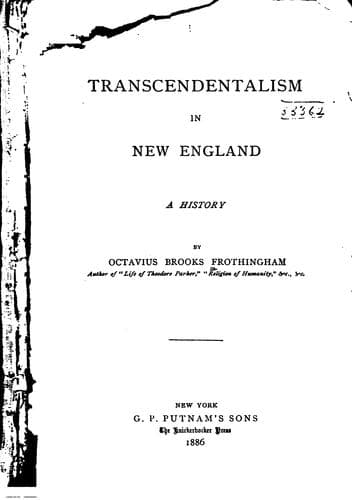
Transcendentalism in New England: A HistoryFrothingham, Octavius Brooks
Philosophy
Transcendentalism in New England: A History
Frothingham, Octavius Brooks
Transcendentalism (New England)
The ablest and most judicial statement on the question was made by
Margaret Fuller in the "Dial" of July 1843. The paper entitled the
"Great Law Suit" was afterwards expanded into the little volume called
"Woman in the XIXth Century," which contains all that is best worth
saying on the subject, has been the storehouse of argument and
illustration from that time to this, and should be read by all who would
understand the cardinal points in the case. The careful student of that
book will be amazed at the misapprehensions in respect to its doctrine
that are current even in intelligent circles. Certainly Miss Fuller does
claim everything that may fairly be comprehended under woman's
education; everything that follows, or may be honestly and rationally
held as following in the course of her intellectual development. But
she claims it by rigorous fidelity to a philosophical idea; not
passionately or hastily. Not as a demand of sentiment, not as a right
under liberty, not as a conclusion from American institutions, but as
the spiritual prerogative of the spiritual being. Her argument moves on
this high table-land of thought; and moves with a steadiness, a
serenity, an ease that little resemble the heated debates on later
platforms. Miss Fuller was thoroughly feminine in her intuitions. It was
impossible for her to treat any subject, to say nothing of a subject so
complex and delicate as this, with any but the finest tempered tools.
Her sympathies were with women; she attracted women by the power of her
intelligence and fellow feeling. Women of feeling and aspiration--pure
feeling and beautiful aspiration,--came to her. The secrets of the best
hearts were revealed to her, as they could not have been, had she failed
to reach or attract them on their own level. Her idea of womanly
character as displayed in sentiment and action was as gracious as it was
lofty.
"We would have every arbitrary barrier thrown down. We would have
every path laid open to women as freely as to man. Were this done,
and a slight temporary fermentation allowed to subside, we believe
that the Divine would ascend into nature to a height unknown in the
history of past ages; and nature, thus instructed, would regulate
the spheres, not only so as to avoid collision, but to bring forth
ravishing harmony."
Yet then, and only then, will human beings, in her judgment, be ripe for
this, when inward and outward freedom for woman as much as for man,
shall be acknowledged as a right, not yielded as a concession.
Public-domain text, read in full here on John Shaqi.
Reviews
Reviews
No reviews yet
Be the first to share your thoughts on this work.
Elsewhere in the archive
Join the Discussion
Join the discussion
Sign in to leave a comment or review.
Sign InorCreate an account