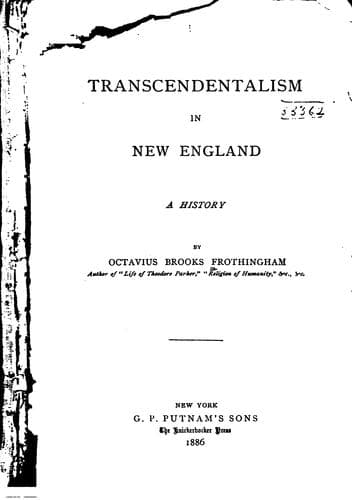
Transcendentalism in New England: A HistoryFrothingham, Octavius Brooks
Philosophy
Transcendentalism in New England: A History
Frothingham, Octavius Brooks
Transcendentalism (New England)
"What woman needs is not as a woman to act or rule, but as a nature
to grow, as an intellect to discern, as a soul to live freely, and
unimpeded to unfold such powers as were given her when we left our
common home. If fewer talents were given her, yet, if allowed the
full and free employment of these, so that she may render back to
the giver his own with usury, she will not complain, nay, I dare to
say, she will bless and rejoice in her earthly birth-place her
earthly lot."
"Man is not willingly ungenerous. He wants faith and love because
he is not yet himself an elevated being. He cries with sneering
skepticism: Give us a sign! But if the sign appears, his eyes
glisten, and he offers not merely approval but homage."
The Transcendental idea makes her just to all, to the Hebrews who
"greeted with solemn rapture all great and holy women as heroines,
prophetesses, nay judges in Israel, and if they made Eve listen to the
serpent, gave Mary to the Holy Ghost;" to the Greeks whose feminine
deities were types of dignity and loveliness; to the Romans, whose
glorious women are "of threadbare celebrity;" to Asiatics, Russians,
English. It gave her generous interpretations for laws, institutions,
customs, bidding her look on the bright side of history.
"Whatever may have been the domestic manners of the ancient
nations, the idea of woman was nobly manifested in their
mythologies and poems, where she appeared as Sita in the Ramayana,
a form of tender purity; in the Egyptian Isis, of divine wisdom
never yet surpassed. In Egypt too, the sphinx, walking the earth
with lion tread, looked out upon its marvels in the calm,
inscrutable beauty of a virgin face, and the Greek could only add
wings to the great emblem." "In Sparta the women were as much
Spartans as the men. Was not the calm equality they enjoyed well
worth the honors of chivalry? They intelligently shared the ideal
life of their nation." "Is it in vain that the truth has been
recognized that woman is not only a part of man, bone of his bone,
and flesh of his flesh, born that man might not be lonely, but in
themselves possessors of and possessed by immortal souls? This
truth undoubtedly received a greater outward stability from the
belief of the church that the earthly parent of the Saviour of
souls was a woman."
Public-domain text, read in full here on John Shaqi.
Reviews
Reviews
No reviews yet
Be the first to share your thoughts on this work.
Elsewhere in the archive
Join the Discussion
Join the discussion
Sign in to leave a comment or review.
Sign InorCreate an account