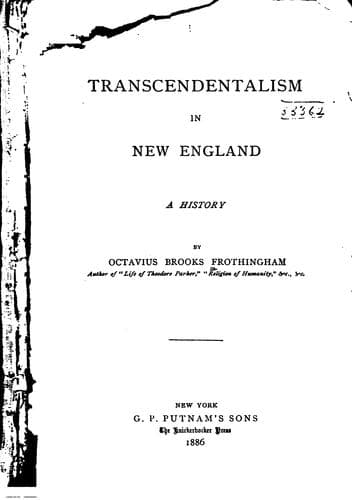
Transcendentalism in New England: A HistoryFrothingham, Octavius Brooks
Philosophy
Transcendentalism in New England: A History
Frothingham, Octavius Brooks
Transcendentalism (New England)
The Transcendentalist believed in man's ability to apprehend absolute
ideas of Truth, Justice, Rectitude, Goodness; he spoke of The Right, The
True, The Beautiful, as eternal realities which he perceived. The
"Sensational" philosophy was shut up in the relative and conditioned;
knew nothing higher than expediency; held prudence, caution, practical
wisdom in highest rank among the virtues; consulted the revelations of
history; recognized no law above established usage; went for guidance to
the book, the record, the statute; it could not speak therefore with
power, but could only consider, surmise, cast probabilities, devise
plans and work carefully towards their execution. The Sensationalist
distrusted the seer, rejected the prophet, and disliked the reformer.
His aim was law; his work within easy distance; his object, some
plainly visible and appreciable satisfaction. His faith in men and women
was small; his trust in circumstances and conditions was unbounded; but
as this faith had no wings, it could neither raise its possessor from
the ground, nor speed him faster than a walking pace. He was easily
satisfied with the world as it was; or if dissatisfied, had little hope
of its being made better by anything he could do. His helplessness and
hopelessness will make him in opinion an optimist, who finds it easier
to assume that the order of the world is perfect and will so appear by
and by, than that it is made imperfect for him to mend. Optimism is
perhaps oftener the creed of the indolent than of the earnest.
Public-domain text, read in full here on John Shaqi.
Reviews
Reviews
No reviews yet
Be the first to share your thoughts on this work.
Elsewhere in the archive
Join the Discussion
Join the discussion
Sign in to leave a comment or review.
Sign InorCreate an account